If you’re setting up a Google Ads campaign, there’s a good chance you’ll run into the same question most advertisers face: Should I start with Search Ads or Performance Max?
There isn’t one answer that works for every business.
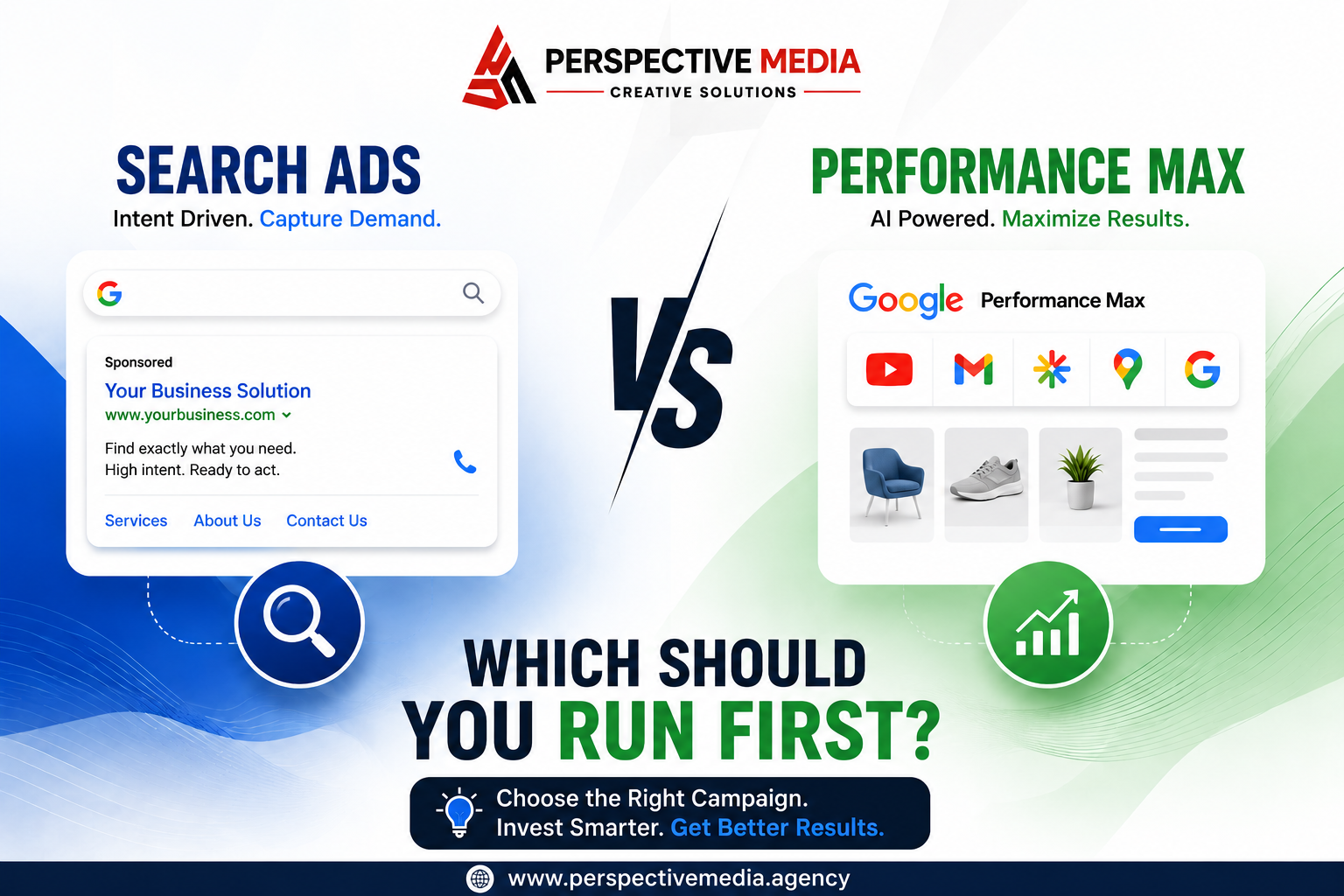
Search Ads give you more control and put your business in front of people who are actively searching for what you sell. Performance Max, or PMax, gives Google’s automation more room to find potential customers across its advertising inventory.
For many businesses that are new to Google Ads, Search Ads are usually the better place to start. They make it easier to understand what people are searching for, which searches generate leads, and where your budget is going.
Performance Max becomes more interesting once you have reliable conversion tracking, useful account data, strong creative assets, and a clear idea of what a valuable conversion looks like.
And for established advertisers, it doesn’t always have to be Search Ads vs Performance Max. Running both can make sense when each campaign has a clear purpose.
Search Ads vs Performance Max: Quick Comparison
Here’s the simplest way to understand the difference.
| Feature | Search Ads | Performance Max |
|---|---|---|
| Main purpose | Capture existing search demand | Find conversions across Google |
| Targeting | Search intent, keywords and signals | Google’s automation and signals |
| Advertiser control | Higher | Lower |
| Automation | Moderate to high | Very high |
| Creative requirements | Lower | Higher |
| Best for new accounts | Often yes | Depends on available data |
| Local lead generation | Excellent starting point | Useful for expansion |
| Ecommerce | Very useful | Potentially very powerful |
| Conversion tracking | Essential | Critical |
| Best use | Capturing high-intent demand | Expanding beyond existing demand |
The biggest difference comes down to control and automation.
With Search campaigns, you have more control over the searches and intent you’re targeting.
With Performance Max, you provide Google with your goals, assets, audience signals, and conversion data, then give its systems more freedom to find conversion opportunities.
What Are Google Search Ads?
Google Search campaigns allow businesses to advertise to people who are actively searching online for relevant products and services. Google describes Search campaigns as a way to reach potential customers when they’re looking for what a business offers. Google’s official Search campaign guide
Think about searches such as:
- emergency plumber near me
- personal injury lawyer
- Shopify development company
- local SEO services
- commercial printing company
These people aren’t casually browsing.
They’re actively looking for something.
That’s what makes Search Ads valuable: you can reach potential customers at the moment they express intent.
How Search Ads Work
You create campaigns around the products or services you want to advertise and build a strategy around relevant searches, keywords, ads, and landing pages.
Depending on your setup, you can control or influence things such as:
- keywords and match types
- negative keywords
- ad copy
- geographic targeting
- landing pages
- bidding strategy
- campaign budget
- ad schedule
Google Search has become increasingly automated, but advertisers still have considerable visibility into the relationship between a customer’s search and the ad experience.
That can be extremely useful when you’re still learning what actually brings in customers.
What Is Performance Max?
Performance Max is a goal-based, highly automated Google Ads campaign type.
Unlike a campaign focused primarily on Search, Performance Max can access Google Ads inventory across Search, YouTube, Display, Discover, Gmail, and Maps from a single campaign. Google also positions PMax as complementary to keyword-based Search campaigns rather than simply a replacement for them. Google’s official Performance Max guide
You give Google the ingredients it needs, including:
- conversion goals
- budget
- audience signals
- text
- images
- videos
- landing pages
- product information when relevant
Google’s systems then use those inputs alongside automation to decide how to serve your ads and pursue your campaign goals.
This is why Performance Max needs to be approached differently from a traditional Search campaign.
You’re giving Google more freedom.
That can be powerful, but it also means the quality of the information you’re feeding the system matters enormously.
Search Ads vs Performance Max: What’s the Main Difference?
Here’s an easy way to think about it:
Search Ads help you capture demand that already exists.
Performance Max can help you expand beyond keyword-based Search and find additional conversion opportunities across Google.
Imagine you own an HVAC company.
Someone searches:
“AC repair near me”
That’s clear intent.
A Search campaign can be built specifically to compete for relevant searches like that.
Performance Max works differently. It can use your goals, conversion history, audience signals, creative assets, and other information to identify additional opportunities to generate conversions.
Neither approach is automatically better.
They’re solving different advertising problems.
Search Ads vs Performance Max: Which Should You Choose?
Before choosing a campaign type, look at the business rather than the Google Ads dashboard.
Here’s a practical framework we use when thinking about Search and Performance Max.
| Business Situation | Search Ads | Performance Max | Search + PMax |
|---|---|---|---|
| Brand-new Google Ads account | Strong choice | Test carefully | Possible later |
| Local service business | Strong choice | Good for expansion | Often useful |
| Limited conversion data | Strong choice | More challenging | Build toward it |
| Strong conversion history | Strong | Strong | Excellent option |
| E-commerce with a strong product feed | Strong | Strong | Excellent option |
| Limited creative assets | Easier | More difficult | Build assets first |
| Need greater campaign control | Better fit | Less control | Depends |
| Want to expand beyond Search | Limited | Strong | Strong potential |
This isn’t a rulebook.
A campaign decision should also consider your budget, margins, location, sales cycle, conversion volume, and the actual value of a customer.
When Should You Start With Search Ads?
For many businesses, Search is a logical place to begin.
You’re New to Google Ads
A new account needs information.
Before trying to automate everything, you need answers to some basic questions:
Which searches actually generate leads?
Which services attract the best customers?
Which landing pages convert?
Which locations perform well?
How much does a qualified lead cost?
Which leads eventually become sales?
Search campaigns can help you gather that information in a relatively controlled environment.
Once you understand what’s working, you have better data for future optimization and automation.
You Run a Local Service Business
Search Ads can be especially useful for businesses where customers actively search when they need help.
For example:
- plumbers
- HVAC contractors
- electricians
- roofers
- dentists
- lawyers
- cleaning companies
- home-service businesses
Someone searching “emergency plumber near me” is giving you a strong indication of what they need.
For a local service business, that level of intent can make Search Ads an excellent starting point.
You Have a Limited Budget
When the budget is tight, you usually can’t afford to chase every possible customer.
You need to focus.
Search Ads can make it easier to concentrate your initial strategy around searches that demonstrate commercial intent.
That doesn’t mean Performance Max can’t work with a smaller budget. It simply means you need to be careful about what you’re testing and how you’re measuring success.
You Want More Control
Some businesses need to understand exactly where their leads are coming from.
Search campaigns generally give advertisers more control over the relationship between:
search → ad → landing page → conversion
That visibility is useful when you’re still figuring out your customer acquisition model.
When Should You Use Performance Max?
Performance Max starts making more sense when you have a stronger foundation.
Your Conversion Tracking Is Reliable
This should come before almost everything else.
Google defines a conversion as an action that’s valuable to the business, such as a purchase, lead, phone call, signup, or other meaningful action. Proper conversion tracking also helps advertisers understand which ads and keywords are contributing to those outcomes. Google Ads conversion tracking documentation
If you’re feeding Google poor conversion data, you’re giving its optimization systems the wrong goal.
For example, imagine your campaign generates 100 form submissions.
Google Ads reports:
100 conversions.
But your sales team discovers that only 20 were qualified leads.
That’s a very different picture.
The goal shouldn’t simply be generating more conversions. It should be generating more of the conversions that actually matter to the business.
Before relying heavily on Performance Max, make sure your conversion tracking reflects real business outcomes.
You Already Have Useful Conversion Data
Automation works from the goals, data, assets, and signals available to it.
If your account has a history of genuine leads or sales, you have more useful business information available when building and optimizing campaigns.
This is why launching Performance Max shouldn’t mean:
“Turn it on and let Google’s AI handle everything.”
Automation still needs a strategy behind it.
You Have Strong Creative Assets
Performance Max can use different types of creative across Google’s advertising inventory.
That means you should be prepared with strong:
- headlines
- descriptions
- images
- videos
- offers
- landing pages
Automation can help determine how assets are used.
It can’t magically turn a weak offer into a great one.
You Want to Scale Beyond Search Demand
Search demand isn’t unlimited.
Eventually, you may reach a point where you’re already capturing a meaningful share of valuable searches.
Google specifically lists expanding reach and conversion value beyond keyword-based Search campaigns as one of the situations where Performance Max can be useful. How Performance Max works according to Google Ads
That’s where combining Search and Performance Max can become particularly interesting.
Is Performance Max Better for E-commerce?
Performance Max can be a strong option for e-commerce businesses, particularly when Google Merchant Center is involved.
But there’s an important catch:
Your product data matters.
Google uses the product information submitted to Merchant Center to match products with relevant queries and as an input for ads and other Google experiences. Accurate and properly formatted product information is therefore an important part of the setup. Google Merchant Center product data specification
Your product information can include things such as:
- product titles
- descriptions
- pricing
- availability
- product images
- identifiers
- landing pages
If your product data is weak or inaccurate, you’re giving the advertising system weaker information to work with.
So before blaming a PMax campaign for poor e-commerce performance, look at the product feed as well.
A strong e-commerce strategy may use Search campaigns alongside Performance Max rather than forcing everything into one campaign type.
Can You Run Search Ads and Performance Max Together?
Yes.
In fact, Google describes Performance Max as a campaign type that can complement keyword-based Search campaigns. Google also has specific prioritization rules governing situations where Search and Performance Max may both be eligible to serve. Google’s Performance Max and Search guidance
Instead of asking:
“Which one should replace the other?”
Ask:
“What job should each campaign do?”
A simple strategy could look like this:
Search Ads → Capture high-intent demand
Performance Max → Expand and pursue additional opportunities
Conversion tracking → Tell Google what matters
Landing pages → Turn traffic into leads or sales
Sales data → Tell you whether those conversions were actually valuable
Now you’re building an acquisition system instead of just running campaigns.
Search Ads vs Performance Max for Local Businesses
Let’s say you’re running a local plumbing, HVAC, or roofing company.
We wouldn’t normally start by throwing the entire advertising budget into automation.
A more controlled approach could look like this.
Step 1: Get Conversion Tracking Right
Track the actions that actually matter.
That might include:
- qualified phone calls
- quote requests
- appointment bookings
- contact forms
Make sure those actions are being recorded correctly before using them to guide campaign optimization.
Google Ads supports different conversion actions for website activity, phone calls, apps, and offline outcomes, depending on the business and measurement setup. Google’s guide to different conversion tracking options
Step 2: Launch High-Intent Search Campaigns
Start with your most valuable services.
Find out which searches bring qualified leads and which simply waste budget.
Review search terms.
Build negative keyword lists.
Improve the landing pages.
Step 3: Improve the Data
As leads come in, don’t stop at the Google Ads conversion.
Ask what happened afterwards.
Was the lead qualified?
Did the customer book?
What was the job worth?
Which services were most profitable?
The closer your advertising data gets to actual business outcomes, the more useful it becomes.
Step 4: Test Performance Max
Once the foundation is strong, test PMax as an expansion channel.
Then compare the results based on business quality, not just the number of conversions reported inside Google Ads.
Search Ads vs Performance Max for E-commerce
E-commerce businesses often have more reasons to use both.
Search Ads can help capture specific product and category searches.
Performance Max can use product data and automation to pursue sales across Google’s advertising inventory.
A good e-commerce setup may combine:
- Search campaigns
- Performance Max
- an optimized Merchant Center feed
- accurate purchase tracking
- first-party customer data
- strong product images
- good landing pages
And one more thing matters:
profit.
A campaign can generate impressive revenue and still be a bad campaign if margins are too low.
Don’t stop at ROAS.
Look at what you’re actually making.
Common Search Ads Mistakes
Targeting Too Many Searches
More clicks don’t automatically mean more customers.
Focus first on searches that have a realistic chance of turning into business.
Ignoring Negative Keywords
Irrelevant searches can quietly eat through a campaign budget.
Reviewing search terms should be part of regular campaign management.
Sending Every Click to the Homepage
If someone searches for a specific service, send them somewhere relevant.
Don’t make potential customers search your website again after they’ve already searched Google.
Chasing Cheap Leads
A cheap lead isn’t necessarily a good lead.
A $30 inquiry that never turns into business can be worse than a $100 lead that becomes a profitable customer.
Common Performance Max Mistakes
Using Poor Conversion Data
If Google is optimizing toward the wrong actions, more automation won’t solve the problem.
Expecting Automation to Fix a Bad Offer
Google can optimize ad delivery.
It can’t fix bad pricing, weak positioning, or an offer nobody wants.
Using Weak Creative
Good campaign technology still needs good advertising.
Give the system strong messaging, images, videos, and landing pages to work with.
Looking Only at CPA or ROAS
Ask what happened after the conversion.
Did those leads become customers?
Did the orders generate profit?
Did the campaign bring in new customers or mostly capture people who already knew the brand?
Those questions give you a much clearer picture of performance.
Search Ads or Performance Max: Which Should You Run First?
If you’re new to Google Ads, particularly as a local or service-based business, Search Ads are often the better starting point.
They give you more control while you’re learning:
- what customers search for
- which services generate demand
- which ads get responses
- which landing pages convert
- what a qualified lead actually costs
Once you’ve built reliable conversion tracking and collected useful data, Performance Max can be tested as an additional growth channel.
If you’re an established e-commerce advertiser with a strong Merchant Center feed, reliable purchase tracking, and enough historical conversion data, Performance Max may deserve a larger role from the beginning.
And if you already have a mature Google Ads account?
You may not need to choose at all.
Search and Performance Max can work together when each campaign has a clear purpose.
Frequently Asked Questions About Search Ads vs Performance Max
Is Performance Max Better Than Search Ads?
Not always. Search Ads provide greater control over high-intent search demand, while Performance Max relies more heavily on Google’s automation to find conversion opportunities across its advertising inventory. The better option depends on your business, data, goals, and budget.
Should Beginners Use Search Ads or Performance Max?
For many beginners, Search Ads are easier to understand and control. They can help you learn which searches, ads, and landing pages generate valuable leads before expanding into more automated campaigns.
Can Search Ads and Performance Max Run at the Same Time?
Yes. Google specifically positions Performance Max as complementary to keyword-based Search campaigns. The two can be used together when each has a clear role. Google Performance Max documentation
Is Performance Max Good for Local Businesses?
It can be, particularly when the business has reliable conversion tracking and useful data. Local businesses should pay close attention to lead quality rather than judging Performance Max only by the number of reported conversions.
Is Performance Max Good for E-commerce?
It can be particularly useful for e-commerce advertisers with accurate product data, reliable purchase tracking, and good creative assets.
Does Performance Max Replace Search Campaigns?
Not necessarily. Search and Performance Max can serve different purposes within the same Google Ads account.
Build a Google Ads Strategy Around Your Business, Not a Campaign Type
The Search Ads vs Performance Max debate can make Google Ads sound more complicated than it needs to be.
Neither campaign type is automatically the winner.
What matters is whether your advertising system can turn the right traffic into profitable customers.
That means connecting:
customer intent → campaign → ad → landing page → conversion → customer → revenue
At Perspective Media, we build Google Ads strategies around that complete journey rather than pushing every business into the same campaign structure.
Whether Search Ads, Performance Max, or a combination of both makes sense depends on your goals, your data, and where your business is today.
If you’re spending money on Google Ads but aren’t sure whether your campaigns are structured for profitable growth, explore our Search Engine Marketing services to see how Perspective Media can help.