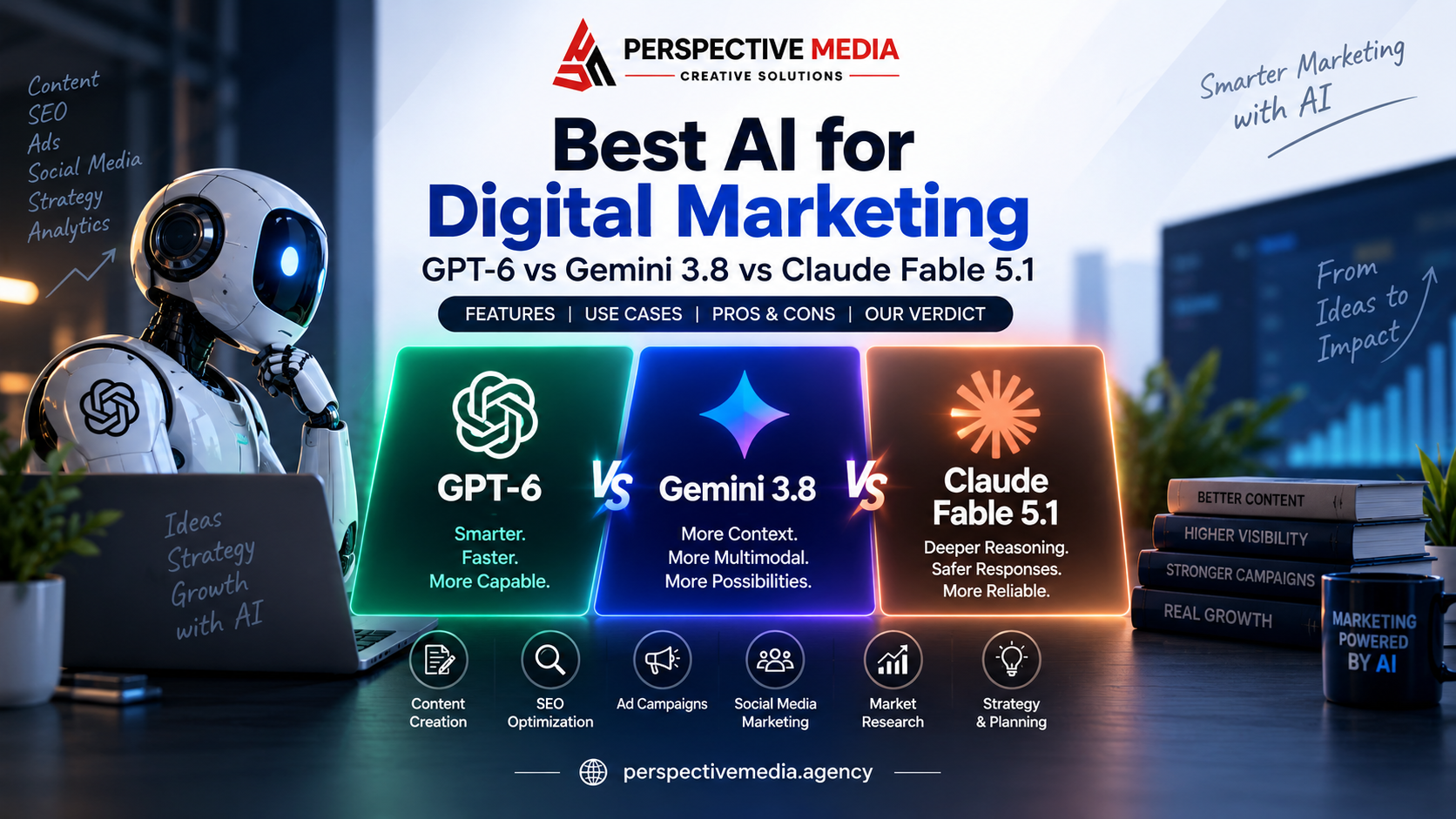
Finding the best AI for digital marketing is no longer as simple as choosing the model that writes the best content. GPT-6 Astra, Gemini 3.8 Flash, and Claude Fable 5.1 can all handle serious marketing work, but they don’t excel at the same things.
A year or two ago, most marketers used AI for relatively simple tasks: writing blog posts, creating social captions, brainstorming ad copy, or generating keyword ideas.
That has changed quickly.
AI is now being used across SEO, GEO and AEO, Google Ads, competitor research, lead generation, sales intelligence, website development, content strategy, and marketing automation.
So when businesses ask us which model is the best AI for digital marketing, our answer isn’t simply “use the newest model.”
The better question is, which AI model is best for the marketing job you’re actually trying to get done?
Because the model we’d choose to analyze thousands of leads isn’t necessarily the model we’d choose to build an SEO strategy, research a competitive market, or troubleshoot a complex website.
Let’s compare them.
Best AI for Digital Marketing: GPT-6 vs Gemini vs Claude
All three models are extremely capable, but they have different strengths.
According to the latest OpenAI release notes, GPT-6 Astra focuses heavily on coding, research, computer use, and complex multi-step work.
Google describes Gemini 3.8 Flash as a model built for complex agentic tasks at scale, with a particular focus on reasoning, coding, agents, and high-volume workloads.
Claude Fable 5.1, meanwhile, is a strong fit for difficult knowledge work, coding, research, and long-form analysis.
For marketers, those differences matter.
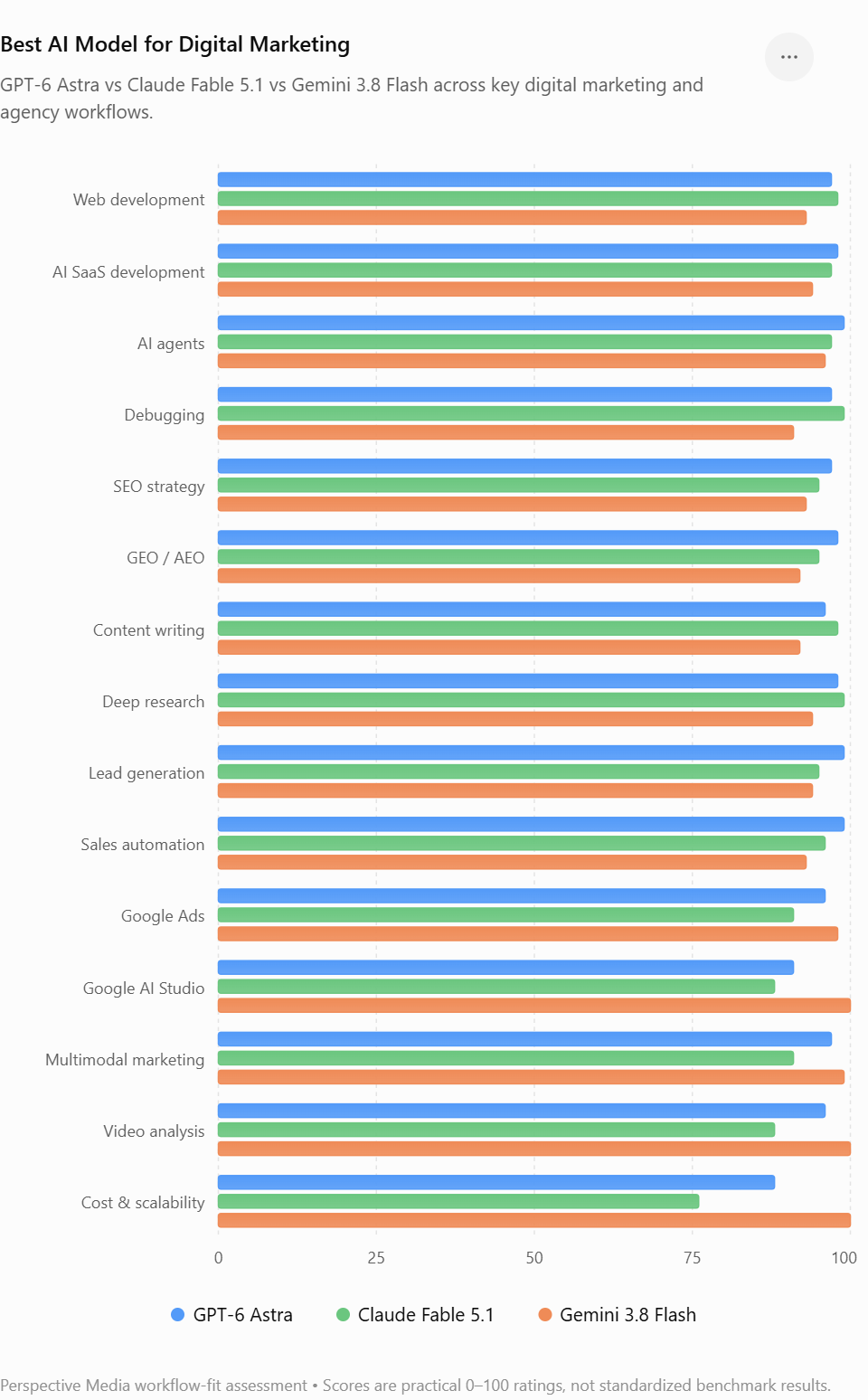
The takeaway from our comparison isn’t that one model destroys the other two.
It’s that we’re reaching a point where model selection should depend on the task.
And that’s actually good news for marketers.
Which AI Model Is Best for SEO?
If we were building an advanced SEO workflow today, GPT-6 Astra would be our first choice for the strategy and reasoning layer.
SEO has become far more complex than putting a keyword into an AI tool and asking it to write 1,500 words.
A serious SEO campaign may involve search intent analysis, keyword clustering, competitor gaps, technical issues, internal linking, topical relationships, content architecture, schema, conversion intent, and increasingly, visibility across AI-powered search experiences.
The challenge isn’t generating each piece individually.
It’s connecting them.
For example, imagine you’re working with a local HVAC company.
Finding 200 HVAC-related keywords is easy.
The harder job is figuring out:
Which keywords deserve dedicated service pages?
Which ones belong together?
Which searches have local or transactional intent?
Where are competitors stronger?
What content is missing?
Which existing pages are competing against each other?
What should be fixed first if the business has a limited budget?
That’s where stronger reasoning becomes useful.
Instead of treating SEO as a collection of disconnected tasks, AI can help turn the data into an actual strategy.
Our pick for SEO strategy: GPT-6 Astra.
Claude Fable 5.1 would still be a strong choice for research-heavy SEO work, while Gemini 3.8 Flash makes more sense when large numbers of pages or records need to be classified and analyzed quickly.
But there is one rule we wouldn’t change regardless of the model:
AI should help an SEO think better. It shouldn’t replace the thinking.
GEO and AEO Are Becoming Part of the Search Conversation
Search itself is changing.
People aren’t only clicking traditional blue links anymore. They’re asking longer questions, comparing products conversationally, using AI Overviews, exploring AI Mode, and getting answers directly from generative systems.
That’s why terms such as Generative Engine Optimization (GEO) and Answer Engine Optimization (AEO) have become part of the marketing conversation.
But there’s also a lot of unnecessary hype around them.
Google’s own guidance for generative AI features in Search makes something very important clear: traditional SEO fundamentals still matter.
Google doesn’t recommend creating content purely for an AI system. It continues to emphasize useful, original content, technical accessibility, a good page experience, and information that genuinely helps users.
Google also says there is no special schema markup required just to appear in AI Overviews or AI Mode.
So GEO shouldn’t mean abandoning SEO and chasing a new collection of tricks.
A better approach is to make your business and content easier to understand, verify, retrieve, and trust.
That can include:
- Clear information about your company, products, services, and expertise
- Strong topical coverage
- Original insights and first-hand information
- Clear answers to important customer questions
- Consistent brand and entity information
- Reliable supporting sources
- Useful images and video where appropriate
- Strong technical SEO
- Logical internal linking
- Structured data that accurately represents visible content
Google’s AI features and website documentation reinforce that existing SEO best practices continue to apply to AI-driven Search.
For this type of work, we’d lean toward GPT-6 Astra for strategy and analysis, especially when the task requires connecting search intent, content, entities, competitors, and business positioning.
But the real advantage won’t come from adding “GEO” to an SEO checklist.
It will come from becoming a source worth retrieving.
Which AI Is Better for Content Marketing?
This is where the comparison gets much closer.
Claude Fable 5.1 is particularly compelling for long-form research and knowledge-heavy writing.
GPT-6 Astra, on the other hand, makes a lot of sense when the content has to fit into a wider SEO, GEO, conversion, or campaign strategy.
So rather than choosing one model and asking it to do everything, we’d split the workflow.
For example:
Research → Claude
Search intent and content strategy → GPT-6
First draft → Claude or GPT-6
SEO/GEO review → GPT-6
Final edit → Human
That last step matters.
A common mistake we’re seeing is businesses assuming that better AI models mean they can simply publish more AI content.
They can.
That doesn’t mean they should.
Google’s guidance on generative AI content specifically warns that generating large numbers of pages without adding value can run into its scaled content abuse policies.
The issue isn’t whether AI touched the article.
The issue is whether the finished article deserves to exist.
Does it say something useful?
Does it answer the question properly?
Does it include experience, evidence, examples, or insight?
Would you still publish it if Google didn’t exist?
Those questions matter more than which model wrote the first draft.
GPT-6 vs Gemini 3.8 for Google Ads
Google Ads is where Gemini becomes particularly interesting.
Google controls an enormous amount of the ecosystem surrounding paid search, shopping, YouTube, analytics, and advertising automation.
At the same time, Gemini 3.8 Flash is designed for high-scale reasoning and agentic workloads.
That combination makes it an interesting model for tasks such as:
- Processing search-term data
- Classifying queries
- Reviewing large campaign reports
- Analyzing landing pages
- Processing product information
- Reviewing image and video assets
- Identifying patterns across large datasets
But we’d make an important distinction.
Analyzing advertising data and deciding advertising strategy are not always the same job.
A model can identify that one campaign has a higher CPA than another.
The strategic question is why.
Is the offer wrong?
Is the traffic poor?
Does the landing page fail to match the searcher’s intent?
Is the campaign targeting people too early in the buying journey?
Is the problem actually sales follow-up rather than advertising?
This is why we’d use Gemini heavily for processing and analysis while using GPT-6 Astra for the higher-level strategy connecting advertising, landing pages, offers, competitors, and customer behavior.
For Google-centric and high-volume workflows: Gemini 3.8 Flash.
For a broader paid-media strategy: GPT-6 Astra.
And in a mature marketing operation, we’d probably use both.
Lead Generation Is Where AI Gets Really Interesting
This is one of the areas where we see the biggest practical opportunity.
A traditional lead list might give a sales team:
Company name
Phone number
Email
Website
Useful? Sure.
But not especially intelligent.
Now imagine the same lead entering an AI-powered workflow.
The system reviews the company’s website.
It checks whether the site is outdated or poorly optimized.
It looks at local search visibility.
It reviews reputation signals.
It compares nearby competitors.
It identifies missing services or weak landing pages.
It evaluates the likely marketing gap.
Then, instead of simply handing a salesperson a phone number, it gives them something like:
Primary opportunity: Local SEO
Secondary opportunity: Website conversion optimization.
Competitive gap: Three major competitors have stronger local landing pages.
Likely pain point: Good reviews but weak organic visibility.
Recommended opening angle: Competitors are capturing high-intent local searches despite having similar ratings.
That’s a very different kind of lead.
It’s closer to sales intelligence.
For this type of multi-step reasoning, GPT-6 Astra would be our preferred intelligence layer.
Gemini 3.8 Flash could handle repetitive analysis at scale, while external data sources and marketing tools provide the verified information.
The AI shouldn’t invent the facts.
It should help you understand what the facts mean.
Marketing Automation Is Moving Beyond Chatbots
For years, “AI marketing” often meant adding a chatbot to a website.
We’re moving well beyond that.
The bigger opportunity is AI agents and connected workflows.
Consider this process:
Find prospect → collect business data → analyze website → identify marketing gaps → compare competitors → score opportunity → create personalized outreach → update CRM → trigger follow-up
There doesn’t have to be a marketer manually copying information between eight different tools at every stage.
That’s where agentic AI becomes much more interesting than a traditional chatbot.
GPT-6 Astra’s focus on complex multi-step work makes it particularly relevant here.
Gemini 3.8 Flash can act as a fast processing layer.
Claude can step in when a workflow encounters a particularly difficult research or technical problem.
In other words, the future marketing stack may not have an AI tool.
It may have several AI systems working behind the scenes.
Where Gemini 3.8 Flash Makes More Sense
There’s another practical issue businesses can’t ignore:
Cost.
The smartest model isn’t automatically the smartest model to use for every task.
Suppose an agency needs to process 100,000 webpages, leads, products, search terms, or records.
Do you really need maximum reasoning power just to classify each page into one of ten categories?
Probably not.
Tasks such as basic extraction, categorization, summarization, image analysis, lead classification, and repetitive data processing can often be routed to a faster and more economical model.
That’s exactly where Gemini 3.8 Flash becomes attractive.
Google positions the model around performance across software engineering and agentic knowledge workflows while allowing different effort levels to balance quality, cost, and latency.
For agencies, that balance matters.
Saving a few cents on one AI request means almost nothing.
Saving it across hundreds of thousands of requests can completely change the economics of an automation system.
Where Claude Fable 5.1 Fits
Claude shouldn’t be viewed as the “third-place model” simply because GPT-6 or Gemini may be a better fit for certain marketing workflows.
That’s the wrong way to think about a multi-model stack.
There are tasks where we’d deliberately route work to Claude, especially:
- Difficult research
- Large-document analysis
- Long-form content
- Technical writing
- Complex coding
- Code review
- Problems that benefit from a second model’s perspective
This becomes even more useful for agencies that build websites, SaaS platforms, internal tools, and marketing automation systems alongside traditional marketing services.
You don’t need every model to win every category.
You need each model to be useful where it’s strongest.
The Smarter Approach Is a Multi-Model Marketing Stack
This is probably the biggest takeaway from our comparison.
We don’t think the future looks like this:
Company → AI model → Everything
It looks more like this:
Business Data + Marketing Platforms
↓
AI Orchestration Layer
↓
GPT-6 Astra → Strategy, reasoning, SEO, GEO, agents and decision-making
Gemini 3.8 Flash → Scale, multimodal analysis, classification and Google-centric workflows
Claude Fable 5.1 → Deep research, complex coding and long-form knowledge work
↓
SEO + Ads + CRM + Content + Sales + Analytics
↓
Human Review and Business Decisions
The important piece in the middle is the orchestration layer.
Instead of employees having to decide which AI model to open every time, the system itself can route the task based on complexity, cost, speed, context, and the type of work required.
That’s where AI starts becoming infrastructure rather than another subscription.
AI Still Can’t Rescue a Bad Marketing Strategy
This is worth saying because it’s easy to get distracted by new models.
If your offer isn’t compelling, GPT-6 won’t magically make customers want it.
If your landing page doesn’t convert, sending more traffic to it won’t solve the underlying problem.
If your tracking is broken, AI will confidently analyze the wrong numbers.
If your lead data is inaccurate, an AI sales agent can personalize the wrong information at incredible speed.
And if your content has nothing original or useful to say, switching from one frontier model to another won’t suddenly make it authoritative.
AI makes good systems faster.
Unfortunately, it can make bad systems faster too.
That’s why the model is only one part of the equation.
Strategy + Data + AI + Execution + Human Judgment
That’s the combination that matters.
What Is the Best AI for Digital Marketing in 2026?
If Perspective Media had to choose only one of these models for an advanced digital marketing operation today, we’d choose GPT-6 Astra as the overall intelligence layer.
Its combination of reasoning, research, coding, computer use, and multi-step capabilities makes it a strong fit for the increasingly connected nature of modern marketing.
But we wouldn’t use it for everything.
Our practical breakdown would be:
GPT-6 Astra—strategy, SEO, GEO/AEO analysis, lead intelligence, marketing agents, sales automation, and complex decision-making.
Gemini 3.8 Flash—large-scale processing, multimodal analysis, repetitive workloads, and Google-centric workflows.
Claude Fable 5.1—deep research, difficult coding, technical analysis, and long-form knowledge work.
The winner, therefore, isn’t necessarily GPT-6, Gemini, or Claude.
The winner may be the company that learns how to use all three intelligently.
The Real Competitive Advantage Isn’t the Model
Six months from now, today’s benchmark charts will probably look different.
Models will improve.
Prices will change.
New versions will launch.
One company will lead a coding benchmark. Another will take the lead in reasoning. Then someone will release a faster model at half the price.
Trying to build your entire AI strategy around whichever model happens to be number one this month is a fragile approach.
Build around the problem instead.
What are you trying to improve?
More qualified leads?
Lower customer acquisition costs?
Better organic visibility?
Greater visibility in AI-powered search?
Faster content production?
Better sales intelligence?
Less repetitive work?
Once the business problem is clear, choosing the AI becomes much easier.
And that is how we think businesses should approach AI at Perspective Media.
Not as another shiny marketing tool.
As a layer that connects better data, better decisions, and better execution.
Ready to Build a Smarter Digital Marketing System?
AI is changing SEO, paid advertising, content, lead generation, web development, and marketing automation at the same time.
But simply subscribing to GPT-6, Gemini, or Claude isn’t an AI strategy.
The real opportunity is figuring out where AI can create measurable value in your marketing operation—and then connecting the right models, data, tools, and people around that opportunity.
If you’re looking for the best AI for digital marketing in 2026, there isn’t one model that wins every category. But if Perspective Media had to choose a single model as the intelligence layer for an advanced digital marketing operation, we’d currently choose GPT-6 Astra.
Its combination of reasoning, research, coding, computer use, and multi-step capabilities makes it a strong fit for the increasingly connected nature of modern marketing. That said, we’d still use Gemini 3.8 Flash and Claude Fable 5.1 for the tasks where their individual strengths make more sense.