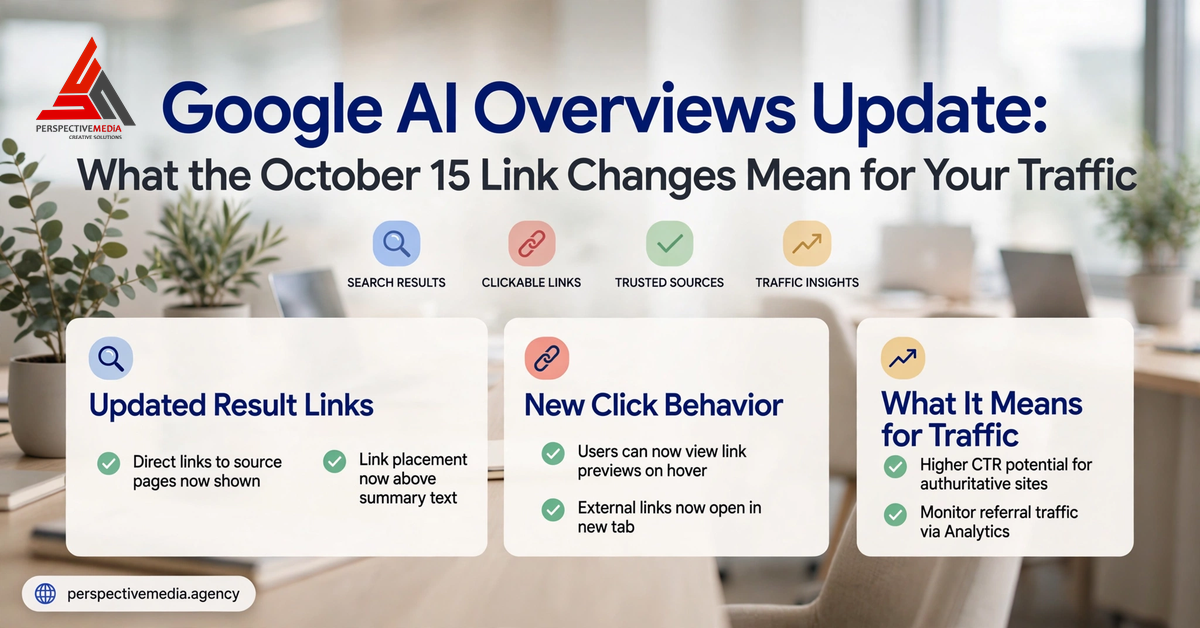
On October 15, 2026, Google published the most consequential AI search change in months — aimed squarely at websites watching AI answers eat their traffic. Announced by Hema Budaraju, Google’s VP of Product Management for Search, the Google AI Overviews update makes links inside AI Overviews and AI Mode more prominent: more inline links placed higher in answers, a test putting official websites in their own section at the top, and news carousels rolling out to more countries and languages.
If AI Overviews have been sitting above your hard-earned rankings while your clicks quietly shrink, this is the update you’ve been waiting for. But Google did not promise you traffic — it promised you visibility. The gap between the two is now the whole game.
What the October 15 AI Overviews Update Changed
Google’s official post lists five changes. Here’s each one, stripped of the announcement gloss:
1. More inline links, shown higher up. Inline links — the links embedded in words and phrases inside an AI-generated answer — have been “continued and substantially” increased, and new updates place them higher in responses more frequently. Sources cited in the first paragraphs of an AI answer get seen; sources buried at the bottom don’t. Placement inside the answer is becoming the new position one.
2. A test section for official websites. Google will test a dedicated section at the top of some answers that prominently surfaces one or two official links — the single places on the web to complete a specific task or get exact information — each with context explaining why it’s useful. Google’s example is an airline refund query showing the refund form and the refund policy at the top. No launch date, no list of qualifying queries.
3. News carousels go global. The prominent carousels of timely articles are rolling out to more locations and languages, and they now highlight the user’s “Preferred Sources” — the publications each searcher has chosen to hear from. Google says Preferred Sources usage has grown more than 7x since the start of the year.
4. “Dive Deeper” links get more clickable. End-of-answer links are being redesigned with image thumbnails and a more engaging, prominent layout.
5. Clickable creator names (test). Google started testing clickable creator and publisher names on video results in AI Mode, linking directly to their Search profiles.
Google also confirmed that 400+ publications are now in its News AI pilot, which pays publishers for content used to develop AI features — a sign of how seriously it’s taking the publisher-traffic question.
Why the Google AI Overviews Update Matters
For two years, the story of AI search has been a story of disappearing clicks. Consultancy Chartbeat reported that news publishers saw roughly a 40% drop in Google-origin traffic between July 2025 and July 2026, and a 2025 Pew Research Center study found users were less likely to click traditional results when an AI summary appeared. Small businesses have felt the same squeeze on commercial queries: the answer sits above your site, cites you (or doesn’t), and the searcher never leaves Google.
This update is Google’s answer to that pressure — but read it carefully. Google is making links easier to see and easier to click, not promising more clicks: as the DesignRush SEO roundup notes, the announcement gives no visit figures, and Search Console’s AI report counts impressions with no click data attached. Only your own analytics can tell you whether a higher-placed link in an AI answer actually moved anyone to your site.
That distinction reshapes the strategy: chase citation placement that earns the click, not “AI visibility” as a vanity metric. The early evidence says Google and ChatGPT are both converging on the same answer to who gets cited: the official source.
Official Sources Are Winning: The Data Behind the Shift
Independent data published this month backs up the direction Google is signalling. Ahrefs analysed 66.6 million ChatGPT responses from August and September 2026, plus the 15 million follow-up searches ChatGPT ran behind them. The findings, broken down by JTS Tech Services, are striking for any business with a website:
- Most ChatGPT answers never search the web at all — only 14.4% triggered a search. Everything else came from what the model already knew.
- When ChatGPT’s follow-up searches were pointed at a single website, 75.9% went to brand sites. Just 1.9% went to Reddit and Facebook combined.
- Searches containing the word “price” rose from 6.0% to 8.9% of English follow-up searches between August and September; “official” rose from 10.1% to 13.1%.
- In a test of 20,000 US prompts, 84.4% of answers to factual questions cited at least one official source.
- The forums lost ground fast: Reddit went from appearing in about one US answer in five in March to about one in 43 by late September. Wikipedia’s citations fell by around 80%.
Pair that with Google’s new test of a dedicated official-sites section at the top of answers, and the direction is unmistakable: when the question is a fact that one organisation owns — the price, the policy, the specification, the booking page — both systems now want to point at that organisation. Our look at what AI agents actually do with business websites covers the machine-readability side: agents read page structure the way a screen reader does, and a fact a human can see may be invisible to them.
For businesses, this is genuinely encouraging news. For years, AI-visibility advice meant chasing mentions on sites you don’t control. The current behaviour rewards the one website you fully own — and the fixes are ordinary, not exotic.
What to Do After the Google AI Overviews Update: 7 Actions
1. Check whether you appear in AI Overviews at all. Open Google Search Console and look at the AI report’s impressions for your key pages. Visibility you can’t see, you can’t improve. Track AI impressions separately from clicks — they measure different things now.
2. Put the facts in the page, in plain text. Price, availability, materials, dimensions, delivery times, returns windows — in the page’s HTML, not only in images, late-loading tabs, JavaScript widgets, or PDFs. An AI checking your site for a fact reads structure first, the way a screen reader does.
3. Give every policy its own plain page. Shipping times, returns windows, warranty terms, exclusions — one dedicated text URL each, linked from your footer and product pages. These “exact info” questions are exactly what Google’s official-pages test targets.
4. Make your official status explicit. If you’re the manufacturer, say so. An authorised dealer should say that plainly too. “Official” is a term the AI searches for more, and you can’t be found for a claim you never make — this entity clarity is the core of Semantic SEO.
5. Structure pages for citation, not just ranking. Self-contained answer blocks, clear headings that mirror real questions, one idea per section — the sources that win the higher-placed inline links are the ones whose text lifts cleanly into an answer.
6. Don’t neglect the human click. A citation is not a conversion: if your cited page is slow, vague, or buries the action, the AI-era traffic bounces back. Our AI Max for Search campaigns breakdown covers the same principle on the paid side: the post-click experience decides what the visibility was worth.
7. Treat the measurement with suspicion for now. ChatGPT’s GPT-6 briefly lost its UTM tagging in early October (attribution gap, since fixed), and rank trackers currently disagree about Google results after anti-scraping changes. Cross-check any sudden shift against Search Console clicks and impressions before rewriting pages or blaming an update.
Google AI Overviews Update: Frequently Asked Questions
Will this update bring my lost traffic back?
Not automatically. Google is making links more visible and clickable — it hasn’t promised more clicks, and Search Console’s AI report still counts impressions without click data. The update helps businesses that are already citation-worthy and easy to click through to; it won’t rescue thin pages.
Do I need a whole new SEO strategy because of this update?
No — the emphasis shifts. Classic SEO (crawlability, content quality, links) still decides whether you’re in the candidate set. The new layer is citation engineering: machine-readable facts, explicit official status, answer-shaped content that survives being lifted into an AI response. An addition to your SEO, not a replacement.
What triggers the new official-websites box?
Google hasn’t said. The test targets queries where “only one or two official places on the web” can complete the task or supply the exact information — refund forms, official policy pages, booking portals. If your site owns a fact (your price, your policy, your booking), state it on a dedicated, readable page and make your official status unambiguous.
Want to know how visible your site actually is inside AI Overviews and AI Mode — and whether the AI can even read your key facts? Request a free SEO audit and we’ll check what the machines see when they visit your site.