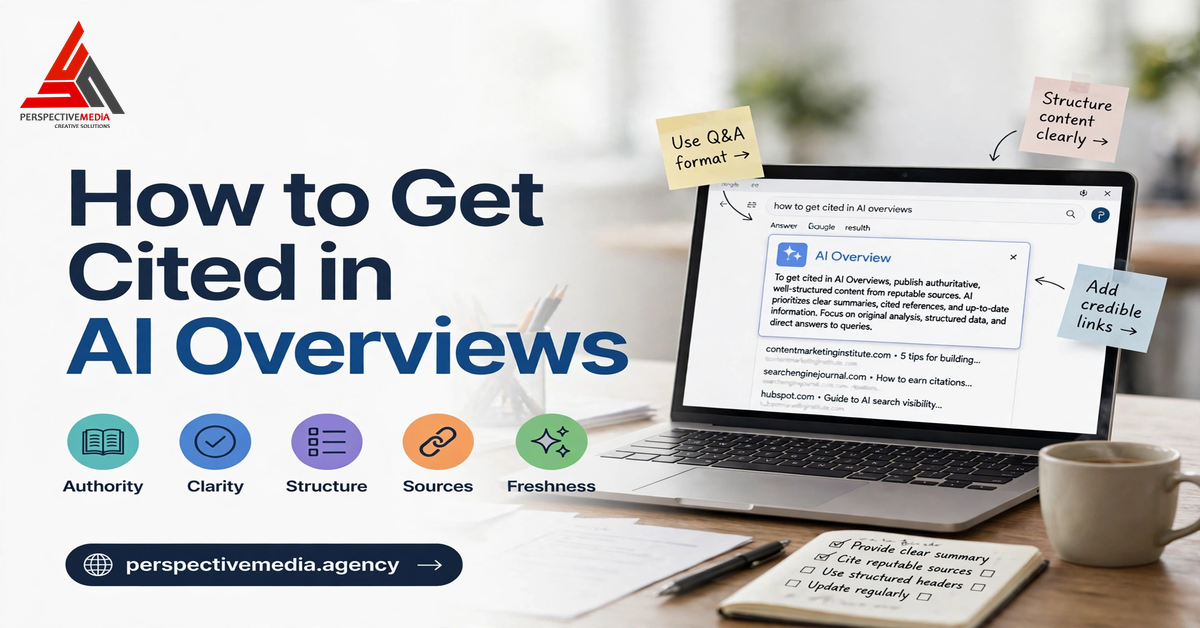
How to get cited in AI overviews is the question every content team is asking now that Google answers many searches directly, before anyone scrolls to the blue links. An AI Overview summarises several sources and links to a handful of them. If your page is one of those links, you stay visible in a search result that used to send you a click. If it is not, your competitor’s name is in the answer instead of yours, and you never even see the lost visit.
There is no application form, no special markup, and no file you can upload to force a citation. Google’s own guidance is blunt on this point: a page must be indexed and eligible to appear in Search with a snippet, and beyond that there are no additional technical requirements for AI Overviews or AI Mode. That sounds like bad news for anyone selling a shortcut. In practice it is good news, because it means the work that earns citations is work worth doing anyway — clear answers, real authority, and pages that already rank. The seven tactics below are ordered by impact, not by novelty.
How to Get Cited in AI Overviews Starts With Ranking
The single strongest predictor of a citation is a ranking you already hold. Independent tracking keeps finding the same pattern: most cited pages already sit in the organic top ten for the same query. One 2026 case study of a UK firm tracked 16 buyer searches and found that 21 of 22 AI Overview citations pointed to a page already in the top ten. Larger studies of millions of citations tell the same story — citations follow rankings far more often than they rescue pages nobody can find.
That reorders the work. Before you rewrite a page for AI search, check where it ranks today. If it sits on page two or three, the highest-leverage move is ordinary SEO: stronger internal links, a clearer page, better coverage of the topic, and a few earned mentions from relevant sites. A page that climbs from position 14 to position 6 has done more for its citation chances than any formatting trick applied to a page Google barely trusts.
This also means you should pick your battles. Choose 15 to 30 searches your buyers actually type — the ones in Search Console, the questions on sales calls, the comparisons prospects ask about before buying — and build one strong page per search. Citations are won page by page, not site-wide. A site with thirty focused, ranking pages will collect far more citations than a site with three hundred thin ones.
Tactic 1: Answer the Question First, in Quotable Language
AI Overviews do not cite pages; they cite passages. Every section of your page should open with a direct answer to its heading, in one to three sentences, written so it can stand alone. No throat-clearing, no “in today’s fast-paced digital landscape,” no paragraph that only makes sense after reading the three paragraphs before it.
A quotable answer has three qualities. It is self-contained, so a reader who sees only those two sentences still learns something complete. It is specific, with numbers, names, or criteria instead of vague claims. And it matches the question’s language — if the heading asks how long something takes, the first sentence gives a time, not a philosophy of patience.
This is the same discipline behind our guide to generative engine optimization, where every section is built to be lifted intact. Write the answer first, then add the detail, examples, and nuance underneath for the human reader who wants more. The readers who click through will thank you too: they skim for the point before committing to the detail.
Tactic 2: Cover the Sub-Questions, Not Just the Headline Question
Google describes a process called query fan-out: for a complex question, its systems run several related searches across subtopics and pull supporting pages for each one. A page that answers only the headline question has one chance to be cited. A page that also answers the natural follow-ups — cost, timing, risks, alternatives, how it compares — has several.
Map the sub-questions before you write. Search Console queries, “People also ask” boxes, support tickets, and the objections your sales team hears are all sources. Give each sub-question its own H2 section with its own direct answer at the top. This is not padding; it is how a single page becomes the obvious source for a whole cluster of related answers.
There is a limit, and Google states it plainly: creating separate pages for every variation of a question mainly to influence AI answers can count as scaled content abuse. One thorough page per real question, with sub-questions answered inside it, is the safe and effective shape. Depth on one page beats a dozen near-duplicate pages every time.
Tactic 3: Make Your Entities Unmistakable
AI systems do not match strings; they resolve things. Before citing your business, the system has to be confident about what your business is, what it does, and where it does it. Vague, inconsistent descriptions across your site make that job harder, and harder means less likely to be cited.
State plainly who you are and what you do, in the same words, across your homepage, your about page, your Google Business Profile, and your directory listings. Use structured data — Organization, LocalBusiness, Article with a real author and date — that matches what a human can read on the page. Schema does not directly cause citations, but it removes ambiguity, and ambiguity is the enemy of being cited.
Authorship matters here as well. Anonymous content is cite-resistant. Real author names, credentials, and a company that is visibly an expert in its field all help an AI system treat your page as a trustworthy source rather than interchangeable text. If a human reading your site would have to guess who wrote it or what the company actually does, a machine will guess too — and it will usually pick a competitor it can resolve with confidence.
Tactic 4: Publish Something Worth Citing
AI engines cite sources that add something new. Original data, documented results, genuine first-hand experience, and expert opinion that cannot be copied from ten other articles are the hardest things for competitors — and for AI models — to replicate. A page that says what everyone says, in slightly different words, gives the system no reason to choose it.
This does not require a research department. A contractor who documents 200 real jobs, an agency that publishes anonymised campaign numbers, a retailer that shares real return-rate data — all of these create citable material. Even a short, honest account of what you tried, what worked, and what did not is more citable than a generic listicle, because it is the only page on the internet that contains that evidence.
Google’s own advice on succeeding in AI search makes the same point from the other side: focus on unique, valuable content for people, and support it with a great page experience. Google’s Search Central guidance on AI search stresses original, satisfying content and pages that are easy to read on any device. Citations are a by-product of being the best answer, not a format you can bolt onto a mediocre one.
Tactic 5: Earn Mentions, Not Just Links
In classic SEO, a link is a vote. In AI search, a mention can be a vote too. AI models train on and retrieve from text that names your brand in authoritative contexts, even without a hyperlink. Digital PR, podcast appearances, expert quotes in industry publications, and genuinely useful contributions to your field all feed the entity graph that AI engines draw on.
This is slow work, and it should be honest work. Chasing inauthentic mentions is one of the tactics Google explicitly warns against, and it will not survive contact with a system designed to weigh source quality. The businesses AI cites most are usually the ones the industry already talks about — because they have done something worth talking about, and said it somewhere other than their own blog.
Start small and relevant: one expert quote for a trade publication, one data point a journalist can use, one genuinely helpful answer in a community your buyers read. A single mention in the right place beats fifty directory listings nobody reads.
Tactic 6: Keep the Page Fast, Fresh, and Easy to Read
Citations are not only about words. A page that is slow, cluttered, or broken on mobile is a page Google is less likely to trust and less likely to surface — in AI formats as much as in classic results. Check the basics before you chase anything advanced: the page returns cleanly, it loads quickly, the main content is easy to distinguish from navigation and pop-ups, and it reads well on a phone.
Freshness matters for topics that change. Statistics, product details, dates, and feature descriptions that are visibly out of date undermine trust in the whole page. Update the actual content when things change; do not just change the year in the title and call it refreshed. For stable, evergreen topics, freshness matters less than accuracy — but a page that still quotes 2023 pricing in late 2026 is telling both readers and machines that nobody is looking after it.
Structured data belongs here too, with one caution: keep it honest. FAQ schema on real question-and-answer content, HowTo schema on real processes, and Article schema with correct author and date fields all help machines parse your page correctly. Markup that describes content that is not visible on the page does the opposite — it teaches the system not to trust you.
Tactic 7: Track Citations Properly, or You Will Chase Ghosts
AI Overviews change constantly. Research tracking tens of thousands of keywords has found a high chance that the Overview — and the URLs it cites — differ from one observation to the next. A single check tells you almost nothing, and reacting to a single screenshot is how teams waste months rewriting pages that were never the problem.
Track like this instead. Freeze a list of 15 to 30 searches. Check them on the same settings — same country, same device, ideally logged out — on a fixed schedule, monthly at least. Record two numbers separately: how many searches showed an Overview at all, and how many of those cited you. Cross-check against Search Console, which now reports impressions from AI features by page. A drop across most of the list, confirmed in Search Console, is worth acting on. A swing on one or two searches is noise.
One tracked case study illustrates why this discipline matters: a firm’s citations dipped sharply during a Google update in early October 2026, then recovered almost fully within weeks once the rollout settled. Teams that had rewritten pages mid-update would have credited or blamed the wrong change. The 2026 case study tracking AI Overview citations shows the method in detail — fixed searches, repeated checks, and results set aside when the captured top ten looks scrambled. Borrow the method, not the panic.
What Not to Do
Three popular shortcuts deserve a clear no. First, llms.txt files and other “AI-only” files: Google says it does not use them, and no special file is needed for eligibility. Second, chopping content into tiny chunks for machines: Google warns against artificial chunking, and it makes the page worse for humans. Third, rewriting pages just for AI systems instead of for readers: Google’s guidance is explicit that optimising for AI search is still SEO, and people-first content is the whole game.
The same applies to measurement shortcuts. No third-party tool has access to Google’s internal ranking or AI systems, so any tool or agency promising guaranteed citations is selling something it cannot deliver. Judge vendors by their method — fixed searches, repeated checks, honest reporting — not by their promises.
The Bottom Line
How to get cited in AI overviews comes down to a simple sequence: rank first, answer directly, cover the sub-questions, make your business unmistakable, publish something original, earn real mentions, and track honestly. None of these steps is a trick, and none of them works overnight. Expect three to six months before citation patterns shift meaningfully, with the fastest wins coming from direct-answer formatting on pages that already rank.
Start this week with the page closest to page one for your most valuable question. Open each section with a direct answer, add the sub-questions your buyers actually ask, and check the result in a month on the same searches. That one page, done properly, teaches you more about AI search than any checklist — including this one.
If you would like that audit on your own site — which questions you are cited for, which competitors appear instead, and what content gaps explain the difference — our team builds entity-driven content programmes designed to earn citations across Google AI Overviews, ChatGPT, and the AI engines your customers actually use. What a good Google Ads agency actually does shows the same discipline applied to paid search: audit before spending, fix the foundations, then scale what the evidence supports.