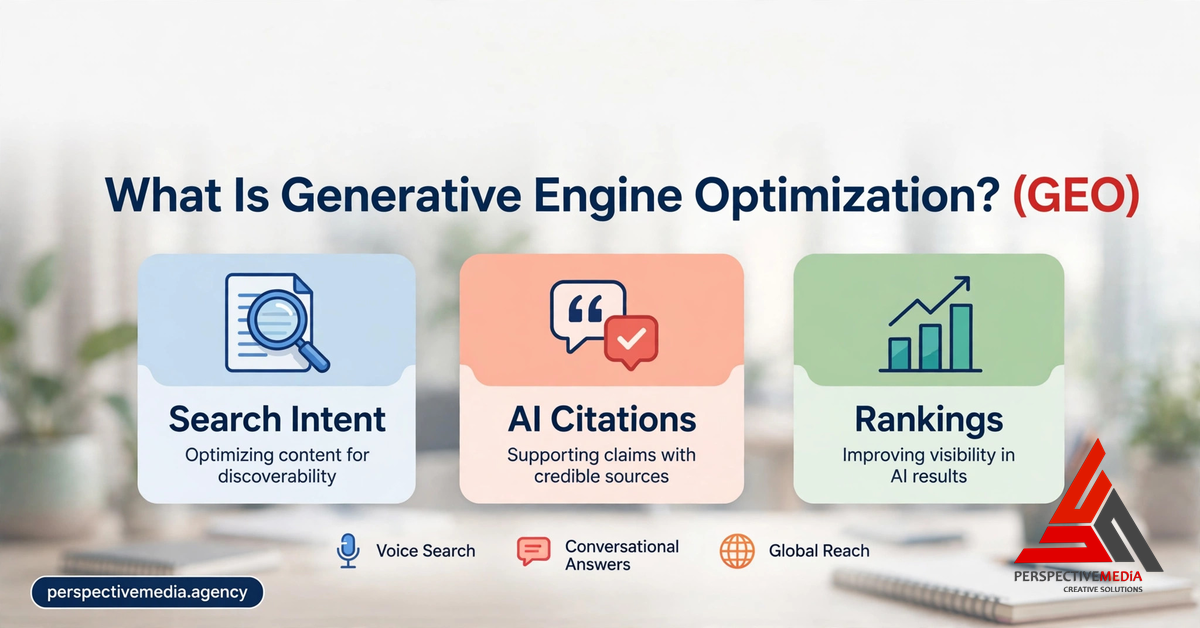
What is generative engine optimization? Put simply: it’s the practice of shaping your content so AI-powered search engines cite your business when they answer questions — not just rank your page tenth, but quote you inside the answer itself.
If you’ve watched Google answer queries directly instead of sending people to websites, you’ve seen why it matters. When AI systems answer, they pull from a small set of sources they trust — and generative engine optimization is how your business becomes one of them.
This guide explains GEO in plain English: what it is, how it differs from traditional SEO, the six building blocks that earn AI citations, and how to measure whether it’s working.
What Is Generative Engine Optimization, Really?
Generative engine optimization (GEO) is the discipline of making your brand’s content the material AI search engines draw on when they generate answers. Classic SEO tries to win a position on a results page. GEO tries to win a citation inside an AI-generated response.
That shift — from rankings to citations — changes what “good content” looks like:
- Entities over keywords. AI models don’t match strings; they resolve things. Your content needs to make it unmistakable who you are, what you do, and where you do it. Clear, consistent descriptions of your business across your site and the web are the raw material AI systems reason over.
- Answers over pages. A 2,000-word page can still lose to a competitor whose single crisp paragraph the AI can lift verbatim. Quotability is a ranking factor now, even if nobody calls it that.
- Passages over documents. AI engines retrieve and cite passages, not whole pages. Every section of your content should stand alone as a complete, self-contained answer.
None of this replaces traditional SEO — crawlability, quality, and relevance still decide whether AI systems find and trust your content. GEO is the layer on top: it turns “Google can read my site” into “AI engines quote my site.” It’s a core part of modern semantic SEO (AEO, GEO, AIO), where optimisation is built around meaning, entities, and answers rather than keyword counts.
How Generative Engine Optimization Differs From Traditional SEO
The easiest way to understand GEO is to compare it with the SEO playbook you already know:
| Traditional SEO | Generative engine optimization |
|---|---|
| Goal: rank in the top 10 blue links | Goal: get cited inside AI-generated answers |
| Optimises for keywords and pages | Optimises for entities and passages |
| Success = clicks and impressions | Success = citations, brand mentions, and referral traffic from AI answers |
| Backlinks are the main authority signal | Brand mentions and quotable expertise carry growing weight |
Notice what hasn’t changed: trust still rules. Google’s official AI Overviews documentation confirms these answers are generated from sources its systems already trust — the businesses getting cited are the ones publishing clear, specific, genuinely useful content on topics they have real authority in. Our breakdown of Google’s October AI Overviews link update shows how fast this surface is evolving — inline links are becoming more prominent, which makes being a citable source more valuable every month.
The 6 Building Blocks of Generative Engine Optimization
1. Define your entities clearly
AI engines need to resolve your business to a thing, not a string of text. State plainly what you are: “Perspective Media is a digital marketing agency in London specialising in semantic SEO and AI automation.” Use the same description consistently across your homepage, about page, Google Business Profile, and directory listings. Structured data (Organization and LocalBusiness schema) reinforces this. If a human reading your site would have to guess what you do, an AI model will too — and it won’t cite what it can’t resolve.
2. Answer questions directly, in quotable language
Every important page should open its key sections with a direct answer: one to three sentences that completely answer the section’s question. Write answers a model could lift verbatim — specific, self-contained, free of throat-clearing. This is the single highest-leverage GEO habit, and it improves your content for human readers too.
3. Publish original data and first-hand experience
AI engines cite sources that add something new. Original research, proprietary data, documented case results, and genuine first-hand experience are the hardest things for competitors — and AI models — to replicate. Google’s guidance on creating helpful, reliable, people-first content explicitly rewards demonstrated experience and expertise. A contractor who’s documented 200 real GBP optimisations will get cited over a generic listicle every time. If your content could have been written by anyone, AI engines have no reason to choose yours.
4. Make authorship and expertise visible
Anonymous content is cite-resistant. Put real author names, credentials, and company attribution on important pages. Link author bios to verifiable profiles (LinkedIn, professional memberships). For businesses, this means the company itself should be a visible expert entity — publishing under a real brand with a real track record, not a faceless blog. AI systems weigh source authority heavily when choosing which sources to surface in answers.
5. Use structured data where it counts
Schema markup doesn’t directly cause citations, but it removes ambiguity — and ambiguity is the enemy of being cited. FAQ schema on question-and-answer content, HowTo schema on processes, LocalBusiness schema on location pages, and Article schema with clear author and date fields all help AI systems parse your content correctly. Think of structured data as labelling your content so machines can’t misread it.
6. Earn brand mentions, not just backlinks
In classic SEO, a link is a vote. In GEO, a mention can be a vote too — AI models train on and retrieve from text that names your brand in authoritative contexts, even without a hyperlink. Digital PR, podcast appearances, and expert quotes in industry publications all feed the entity graph AI engines draw on. The businesses AI cites most are usually the ones the industry already talks about.
How to Measure Generative Engine Optimization
Four signals are worth tracking from day one:
- Citation checks. Regularly prompt the major AI engines (Google AI Mode, ChatGPT, Perplexity) with your target questions and record whether — and how — your brand appears. Do this monthly; it’s manual, but it’s the ground truth.
- Brand search lift. As AI answers mention your brand, branded search volume typically rises. Watch Google Search Console for growth in queries containing your business name.
- AI referral traffic. ChatGPT, Perplexity, and Copilot now send measurable referral traffic. Segment it in GA4 so you can see which pages AI users land on.
- Zero-click visibility. Track impressions and average position in Search Console alongside the above — pages earning AI citations often hold strong traditional visibility too, and the combination compounds.
Set a quarterly review: which questions do you get cited for, which competitors appear instead of you, and what content gaps explain the difference. AI automation can help here — scheduled monitoring prompts and reporting turn citation tracking from a chore into a dashboard.
Generative Engine Optimization FAQs
Is GEO replacing SEO?
No. GEO builds on SEO — AI engines cite sources they already trust, and that trust is earned through quality content, technical soundness, and authority. Treat GEO as the answer-layer on top of a solid SEO foundation.
How long does GEO take to work?
Expect 3–6 months before citation patterns shift meaningfully. AI engines update their retrieval indexes on their own schedules, and entity-level trust builds gradually. The fastest wins usually come from direct-answer formatting on pages that already rank — AI systems cite trusted pages first.
Do small businesses need generative engine optimization?
Yes — arguably more than large ones. AI answers flatten the field: a well-structured page from a local specialist can be cited ahead of a generic national brand. For service businesses, GEO is also defensive — if AI answers your customers’ questions using your competitor’s content, you’re losing enquiries you never see.
What’s the difference between GEO and AEO?
They’re siblings. Answer engine optimization (AEO) focuses on winning direct answers — featured snippets, voice replies, the single spoken answer. Generative engine optimization (GEO) focuses on being cited inside AI-generated responses. The tactics overlap heavily: clear entities, direct answers, structured data. Most businesses should pursue both as one programme.
The Bottom Line
What is generative engine optimization, in one sentence? It’s making your business the source AI search engines quote. The tactics — clear entities, direct quotable answers, original experience, visible expertise, structured data, brand mentions — all make your content better for humans too. That’s the real opportunity: GEO rewards you for writing so clearly that even a machine can’t misunderstand you.
If AI search is already answering your customers’ questions, the only question is whose content it’s quoting. Our semantic SEO (AEO, GEO, AIO) service builds entity-driven content programmes designed to earn citations across Google AI Overviews, ChatGPT, and the AI engines your customers actually use. Start with a free SEO audit and we’ll show you where your brand stands in AI answers today — and what it takes to get cited.