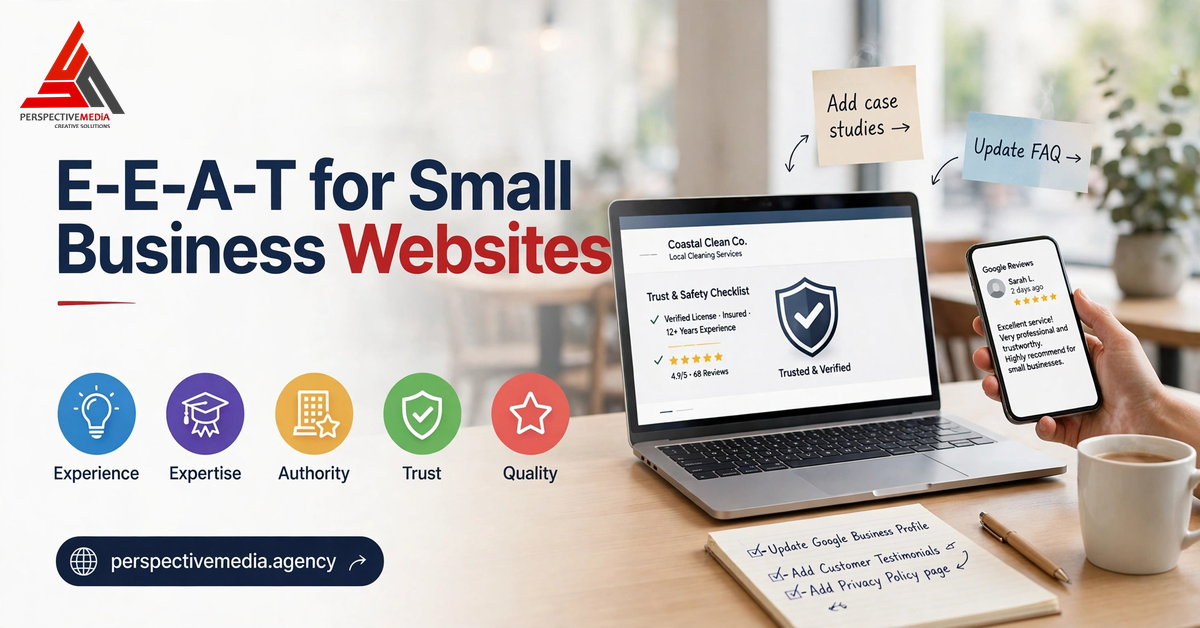
E-E-A-T for small business websites is one of those phrases that sounds like insider jargon until you translate it. It stands for Experience, Expertise, Authoritativeness and Trustworthiness. Google uses these four ideas to judge whether a page deserves to rank, especially when the topic affects someone’s money, health or safety. For a small business, that judgement decides whether your website shows up when a local customer searches, or whether a bigger competitor takes the click.
The good news is that E-E-A-T is not a secret formula or a plugin you install. It is a set of signals you build into your pages, one concrete detail at a time.
What E-E-A-T Means in Plain English
Google first described E-E-A-T in its Search Quality Rater Guidelines, the manual its human raters use to judge search results. Google’s own guidance on creating helpful, reliable, people-first content puts it simply: content should show experience, expertise, authoritativeness and trustworthiness.
Experience
Experience means first-hand involvement. A plumber who has fitted a hundred boilers writes differently from someone who has only read about boilers. Google looks for real photos from real jobs, details only a practitioner would know, and before and after results.
Expertise
Expertise is knowledge and skill in the topic. For a trades business, that is qualifications, years on the tools, and the ability to explain a technical decision in plain language. For a clinic or a financial adviser, the bar is higher, because bad advice there can cause real harm.
Authoritativeness
Authoritativeness is reputation: what other people and other websites say about you. Mentions in local press, listings in respected directories, links from suppliers and reviews from real customers build it over time. You cannot declare yourself authoritative. You earn it.
Trustworthiness
Trustworthiness is the foundation the other three stand on: accuracy, transparency and safety. A real address and phone number, clear ownership, honest claims, secure pages, and content that is correct and up to date.
Why E-E-A-T for Small Business Websites Matters More in 2026
Big brands start with built-in authority: thousands of mentions and a name people already search for. A small business has none of that, so every signal on its own site carries more weight.
Three shifts make this urgent. First, AI Overviews answer more questions directly on the results page, and they cite sources that look credible. Our guide on how to get cited in AI Overviews explains the content patterns that earn those citations, and trust signals sit at the centre of them. Second, customers research harder before they call: a thin page with no author, no reviews and no evidence loses to a competitor whose site proves its claims. Third, Google keeps getting better at telling genuine expertise from content written only to rank. None of this needs a big budget. It needs consistency: the same business details everywhere, real evidence on every important page, and content written by people who know the work.
Experience: Show the Work, Not Just the Claim
Experience is the easiest E-E-A-T signal to build, because you already have it. Start with your service pages. A page that says “we install kitchens” tells Google nothing. A page that shows three recent installs, with photos, materials and timings, tells Google a great deal. Real photos beat stock photos every time. Name the neighbourhoods you worked in.
Add a short author note to your blog posts: “Written by Sarah, who has managed our roofing team for nine years.” Link that name to a bio page. That one link connects the content to a real person with real experience. Case studies are experience in its strongest form: a short write-up of a real job, the problem, what you did, and the result, with a photo and a customer quote. One a month gives you a library of proof within a year.
Expertise: Prove You Know Your Trade
Expertise shows in the quality of your answers. When a customer asks a question, your content should answer it completely, accurately and in plain language. Write about the decisions your customers actually face, not the keywords you wish they searched. A good test: read your page and ask whether a competitor could have written the same words without ever doing the job. If the answer is yes, the page is too generic. Add the detail only a practitioner knows: the exact regulation in your area, the reason one material fails in damp conditions, or the mistake you see other firms make most often.
Keep your content current. An article citing a regulation from three years ago quietly damages trust. Review your most visited pages twice a year and add a “last updated” note. If you hold qualifications, show them: a Gas Safe number or a trade body membership belongs on your about page and on the pages it relates to.
Authoritativeness: Earn Mentions Beyond Your Own Site
Authority is built off your site as much as on it. The strongest signal is other reputable websites mentioning or linking to your business. You cannot buy this honestly. You earn it by being worth mentioning. Local press is an underused route: a genuine story, a community project or an expert comment on a local issue can earn a mention from a newspaper or a community site. Suppliers and trade bodies are another: ask whether your membership profile can link to your site. Our entity SEO explainer covers why these consistent mentions help Google understand your business as a real entity, not just a website.
Reviews are the most visible form of authority for a local business. A steady flow of genuine Google reviews, answered by the owner, does more for trust than any badge. Never buy reviews and never write your own. Ask happy customers at the right moment, make it easy with a direct link, and reply to every review.
Trustworthiness: The Foundation Under Everything
Trust is where E-E-A-T is won or lost for most small businesses. Make your business easy to verify: a real address, phone number and email on your contact page, and the people behind the business, with photos, on your about page. A contact form as the only route to a human is a red flag for both Google and customers.
Be honest in your claims. Do not promise results you cannot guarantee, use testimonials you cannot attribute, or show logos of organisations you are not a member of. A visitor who spots one false claim assumes the rest are false too. Keep the site secure and maintained: HTTPS is a basic expectation now, and broken links and outdated pages signal neglect. When you cite a statistic or a rule, link to the source. The Semrush guide to E-E-A-T is a useful second reference on how the framework applies across industries.
An E-E-A-T for Small Business Checklist You Can Finish This Week
Work through this list in order. Most items take under an hour.
- Add a real author byline and bio link to your five most visited blog posts.
- Replace stock photos on your top three service pages with real photos from real jobs.
- Add one short case study to your site.
- Check that your business name, address and phone number match exactly on your website, your Google Business Profile and your main listings.
- Add your qualifications and certifications to your about page.
- Put a “last updated” date on key pages, fix broken links, confirm HTTPS, and link every statistic to its source.
None of these steps is difficult. Together, they turn a website that merely describes a business into one that proves it.
Frequently Asked Questions
Does E-E-A-T affect rankings directly?
Not as a single score. Google has said E-E-A-T is not a direct ranking factor. It is a framework its quality raters use, and the systems learn from that feedback. In practice, pages that demonstrate experience, expertise, authority and trust tend to rank better.
Can a small business compete on E-E-A-T with a big brand?
Yes. Big brands struggle to show genuine first-hand experience on every page. A small business owner who has done the work for twenty years can show it directly, with real photos, real cases and a real name attached.
How long does it take to build E-E-A-T signals?
Some fixes are instant: author bylines, correct business details, HTTPS, updated pages. Authority takes longer, because reviews and mentions accumulate over months. A little every month compounds into a strong profile within a year.
Trust Is the Ranking Factor You Can Control
E-E-A-T for small business websites comes down to a simple idea: show your work, prove you know your trade, earn mentions from others, and make your business easy to trust. It needs a few honest pages, real evidence, and the habit of keeping them current.
If you want a second pair of eyes on your site, our Semantic SEO service covers the technical and content work that turns these signals into rankings. Or start with the checklist above, and give it a month. The businesses that win in search are rarely the loudest. They are the ones whose websites prove they can be trusted.