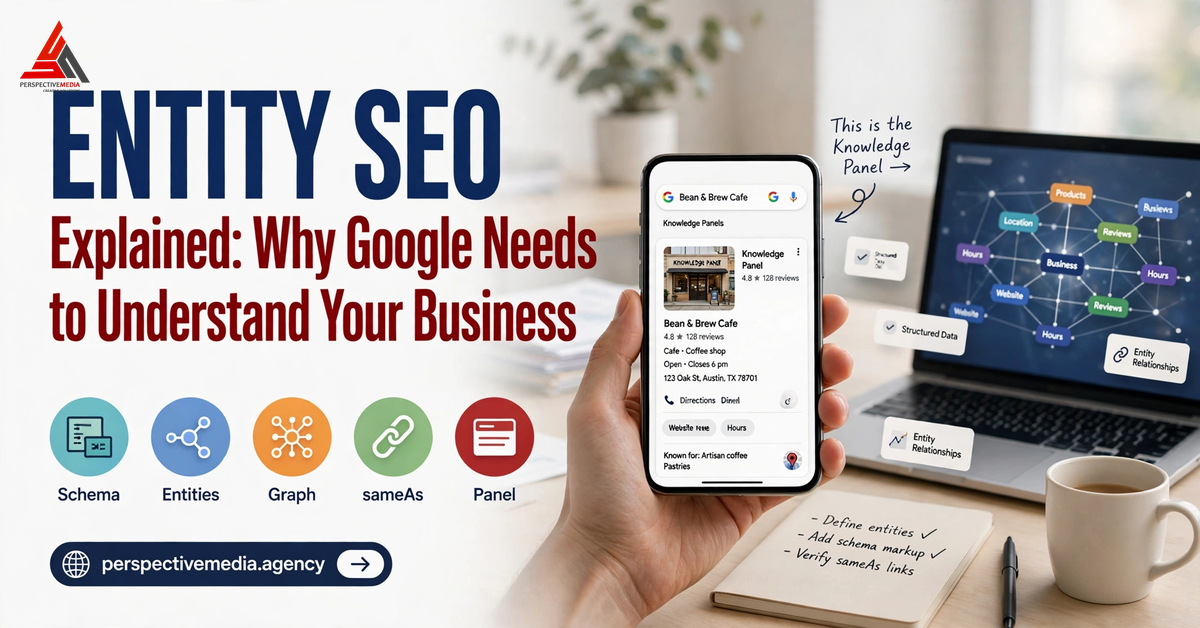
For years, SEO was mostly a game of matching words. Google scanned pages for keywords, and the sites that used the right phrases in the right places tended to rank. That era ended quietly some time ago. Today, entity SEO — the practice of helping Google understand your business as a real-world entity with attributes, relationships and a reputation — is one of the most important ranking factors most small businesses have never heard of.
An entity is Google’s way of saying “a distinct, identifiable thing”: a business, a person, a place, a product, a concept. When Google truly understands who you are — not just which keywords appear on your homepage — everything changes: your eligibility for knowledge panels, your accuracy in AI-generated answers, and your resilience when competitors outspend you on content.
What Entity SEO Really Means: From “Strings” to “Things”
In 2012, Google introduced the Knowledge Graph with a phrase that became the unofficial motto of entity SEO: “things, not strings.” The idea was simple and profound: when someone searches for “Persian cats,” Google shouldn’t just match the words — it should understand the thing behind them, and answer with a knowledge panel showing facts, images and related entities.
Since then, Google has built an enormous map of entities and their relationships: businesses connected to their founders, founders connected to awards, awards connected to industries, and so on. Modern search indexes what your words mean and how your business connects to everything Google already knows.
This is why two businesses can publish near-identical service pages and get wildly different results. One is a known entity with verified facts, consistent listings and authoritative relationships. The other is, to Google, just a website with words on it.
Why Entity SEO Changes How You Plan Content
Traditional keyword research asks: “Which phrases do we want to rank for?” Entity SEO adds a deeper question: “Which entities do we need to be associated with, and what does Google currently believe about us?”
That shift changes content planning in three ways:
You write for topics, not terms. A topical map built around entities covers a subject’s people, places, products, processes and problems, instead of chasing dozens of thin keyword variants. A plumbing company writing about boilers naturally connects entities: Worcester Bosch, annual servicing, Gas Safe registration, central heating systems. Covering those entities builds topical authority far better than repeating “boiler repair London” twenty times.
You answer the questions searchers actually ask. Google’s entity model powers the questions that appear in “People also ask” and now in AI Overviews. Content that defines entities clearly — what something is, how it relates to the reader’s problem — gets understood, and understood content gets cited. Our guide on how to get cited in AI Overviews builds directly on this principle.
You stop competing on keywords alone. When Google recognises your business as a legitimate entity in your space, you gain an advantage that content farms can’t copy cheaply. Entity recognition compounds: consistent signals today make every future page slightly easier to rank.
The Entity SEO Toolkit: Schema, sameAs and Disambiguation
Google can’t interview you, so it reads signals. Here’s how to make your entity explicit:
Structured data (schema markup). Schema.org markup translates your page’s facts into a language search engines parse unambiguously. An Organization schema tells Google your legal name, founding date, location and contact details; LocalBusiness subtypes add opening hours and geo-coordinates; sameAs properties link the schema to your official profiles on LinkedIn, Companies House or Trustpilot. These links are how Google merges mentions of your business across the web into one confident entity. Start with Google’s structured data documentation for the official implementation rules.
Entity disambiguation. If your business shares a name with something else — and many do — you must actively tell Google which one you are. SameAs links, a detailed “About” page, and mentions that consistently pair your name with your city, industry and founder’s name help Google separate you from the namesake.
NAP and entity consistency. Your name, address and phone number must be identical across your website, Google Business Profile and every directory that matters. Inconsistent variants (“Perspectiva Media” here, a different phone number there) fragment your entity into weaker duplicates. We covered the cleanup process in our guide to NAP consistency — and entity SEO is the deeper reason that cleanup matters.
Authoritative relationships. Who links to you, who mentions you, and which entities those sources themselves represent all feed your entity’s credibility. A mention on an industry publication, a verified review profile, a speaking slot at a conference — each teaches Google more about what you are.
How to Build Entity Recognition, Step by Step
Here’s the practical sequence we run for clients:
Map every entity your business owns
List your company, brand variations, founders and key staff, services, locations, industries served, notable clients and any awards or certifications. This is your entity inventory — the set of “things” Google should understand about you. Prioritise the entities that matter commercially: your company, your flagship service, your primary market.
Wire entities together with schema and sameAs
Add Organization (or the right LocalBusiness subtype) schema to your homepage and About page, with sameAs links to every authoritative profile you control. Add Person schema for founders where it matters, Service schema for core offerings, and FAQPage or HowTo where relevant. Test everything in Google’s Rich Results Test. This is the single highest-leverage entity SEO task most sites haven’t done.
Keep your entity consistent everywhere
Audit your NAP across Google, Bing, Apple Maps and the directories that count in your market, and fix every variant you find. Then extend consistency beyond the basics: your business description should use the same wording for what you do across your site, profiles and press mentions. Consistency isn’t exciting — it’s the foundation.
Disambiguate and reinforce
If name collisions exist, strengthen the separating signals — location-qualified mentions, founder attribution, industry context — and keep reinforcing: every press mention, listing or announcement should describe your business the same way, adding another vote to the same entity.
Entities in the AI Search Era
Entity SEO has become more important, not less, with the rise of AI search. When Google’s AI Overviews answer a question, they summarise and cite sources — and the sources that get cited are the ones Google understands with confidence. A well-defined entity with clear relationships, consistent facts and authoritative mentions is far easier for an AI system to summarise accurately than an ambiguous one.
Chat-based search works the same way: large language models lean heavily on entity-rich signals. If your business is a fuzzy, half-defined presence, AI assistants will describe you vaguely — or worse, conflate you with a namesake. Entity work today is a down payment on AI visibility tomorrow.
Entity SEO: FAQs
What is entity SEO in simple terms?
Entity SEO is the practice of helping search engines understand your business as a distinct, real-world “thing” — with attributes like its location, services and founder, and relationships to other entities — rather than just matching the keywords on your pages.
How is entity SEO different from traditional SEO?
Traditional SEO optimises pages for keyword phrases. Entity SEO optimises your identity across the web: structured data, consistent business facts, authoritative mentions and clear relationships. The two work together — entity strength amplifies everything keyword-focused SEO achieves.
Does my small business really need entity SEO?
Yes — arguably more than a big brand does. Big brands are already entities in Google’s knowledge graph; small businesses often aren’t. Building entity recognition is how a small business becomes a known quantity instead of an anonymous website competing purely on keywords.
What is sameAs in schema markup and why does it matter?
The sameAs property in schema.org markup points from your website to other authoritative pages representing the same entity — your LinkedIn page, Companies House listing, Trustpilot profile — helping Google merge scattered mentions into one strong entity.
How long does entity SEO take to show results?
Expect 2–4 months for structured data and consistency fixes to consolidate, with compounding gains over 6–12 months as authoritative mentions accumulate. Entity recognition builds like reputation: slowly at first, then accelerating as each new signal reinforces the last.
Can entity SEO help me get a Google Knowledge Panel?
It significantly improves your chances. Knowledge panels draw on entity understanding, and a business with verified facts, consistent listings, sameAs connections and authoritative mentions is exactly what Google’s systems need to feel confident enough to show one. There’s no application process for most panels — the signals do the work.
If your business is invisible as an entity, every ranking battle is fought uphill. Structured data, consistency and authoritative relationships are the highest-ROI foundations you can build — and exactly the groundwork our Semantic SEO service covers. Want a clear picture of how Google currently sees your business? Start with an entity audit: map what it knows, find the gaps, and fix the signals that matter.