Most Dubai businesses don’t have a traffic problem. They have a content problem. Paid ads bring clicks, but the moment the budget pauses, the pipeline goes quiet. That’s why hiring a content marketing agency in Dubai is less about “getting blogs written” and more about building a content engine — a system that compounds traffic and leads long after the ad budget pauses.
This guide shows what that engine looks like for UAE brands: the formats that work here, a sustainable cadence, bilingual considerations, and how to spot a serious agency.
What a Content Marketing Agency in Dubai Actually Does
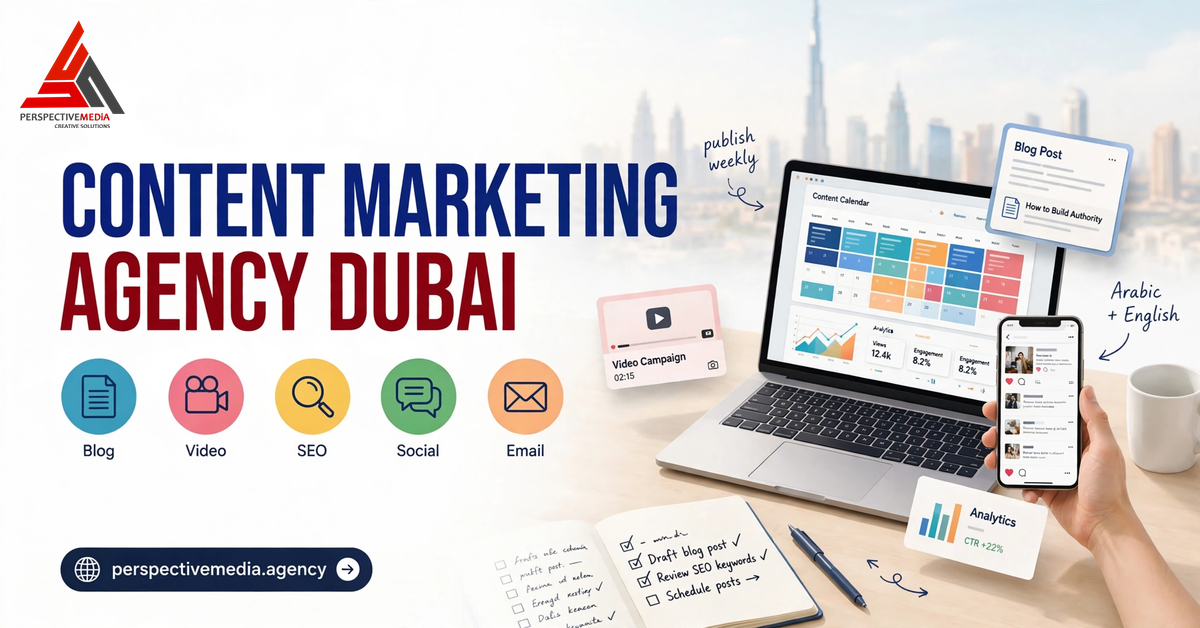
Strip away the buzzwords: a content agency turns search demand and social attention into revenue, across five tracks:
- Strategy and keyword research. Mapping what your buyers actually search — in English and, where relevant, Arabic — and matching each query to a page type: pillar guides, service pages, comparison posts, FAQs. Which is why content strategy should be its own engagement before a single article is written.
- Editorial production. Long-form guides, case studies, white papers, and location pages written to Google’s guidance on creating helpful content — content made for people, not for crawling tricks.
- Multimedia adaptation. The same core ideas repackaged for how Dubai actually consumes: short-form video for TikTok and Reels, carousels for Instagram and LinkedIn, voice notes and PDFs for WhatsApp nurture sequences.
- Distribution. Publishing without distribution is a diary. Good agencies place content where the audience already is — organic search, LinkedIn, email, and paid amplification for hero pieces.
- Measurement. Traffic is a vanity metric. The dashboard that matters shows pipeline: marketing-qualified leads, assisted conversions, and cost per acquisition falling quarter over quarter.
Notice what’s missing from that list: vanity deliverables. If an agency’s proposal is “12 blog posts per month” with no keyword map, no distribution plan, and no revenue model attached, you’re buying words, not a growth engine.
Content Formats That Work in the UAE Market
The UAE is one of the most digitally connected markets in the world, documented in DataReportal’s Digital 2026 UAE report — and through our work with UAE brands, four formats consistently earn their keep:
Search-led pillar content
Dubai buyers research like buyers everywhere: they Google. Long-form pillar guides answering commercial-intent questions (“cost of X in Dubai,” “best Y for Z in the UAE”) capture demand at the decision moment. They also feed being cited in AI Overviews — comprehensive content gets quoted; thin content vanishes.
LinkedIn thought leadership
Dubai’s B2B scene lives on LinkedIn. Founders publishing weekly — deal observations, regulatory explainers, market commentary — build a personal brand that feeds the company brand. One sharp post a week that a decision-maker would forward beats daily hustle posts.
Short-form video
TikTok, Reels, and Shorts dominate consumer attention in the Emirates. The trick is repurposing: one pillar article becomes five short videos, each answering one question — planned in the same brief.
WhatsApp and email nurture
Property, education, and services businesses in Dubai close deals over WhatsApp. Gated content — a pricing guide, an admissions checklist, an ROI calculator — delivered inside a WhatsApp thread converts far better than the same asset behind a generic landing page.
Content Cadence: How Often Should a Dubai Brand Publish?
Cadence depends on your competitive set, but a sustainable baseline for most UAE businesses looks like this:
- 2–4 search-optimized articles per month — depth beats volume; one 2,000-word guide that ranks beats ten 500-word fillers.
- 4–8 LinkedIn posts per month — founder-led, opinionated, tied to real market events.
- 8–12 short videos per month — repurposed from the articles and LinkedIn posts, not shot from scratch.
- 2–4 email/WhatsApp broadcasts per month — new content drops plus one nurture sequence running in the background.
Consistency beats intensity: two genuinely useful pieces a month for a year outperforms daily publishing for six weeks. Against your wider digital marketing in Dubai plan, content is the compounding layer underneath paid and social — the asset base everything else links back to.
Arabic vs English: The Bilingual Question Every Dubai Brand Faces
Here’s the honest answer: for B2B and most premium B2C in Dubai, English-first covers the buying population — the city’s business language is English, and so is its search behavior. But ignoring Arabic leaves money on the table in three places: government and semi-government tenders, Saudi-facing expansion, and consumer segments where Arabic content faces less competition.
The smart approach is a tiered one:
- Core commercial content in English first — this is where the volume and the revenue are.
- High-intent Arabic versions of money pages — service pages, pricing explainers, and location pages translated and localized (not machine-translated) for Arabic search queries.
- Arabic social content for reach — short-form video in Arabic or bilingual formats often outperforms English-only on TikTok and Snapchat in the Gulf.
Google’s regional insights show MENA audiences engaging deeply with video and mobile-first formats — so when you go Arabic, lead with video, not articles. And ask any agency how they handle Arabic copywriting: if the answer is “translation software,” keep looking.
How to Evaluate a Content Marketing Agency in Dubai
Choosing a content marketing agency in Dubai comes down to a handful of diagnostic questions for the first call:
- “Show me your keyword map.” A real agency arrives with research: the queries your buyers search, the pages that target them, and the gaps competitors are missing. No map, no strategy.
- “What does distribution look like?” If their plan ends at “we publish on your blog,” they don’t understand distribution. Ask how a single piece reaches search, social, and email.
- “How do you measure success?” Listen for revenue-adjacent metrics — leads, assisted pipeline, ranking positions for commercial terms. Run from anyone whose main KPI is “number of posts published.”
- “Who writes, and do they know my industry?” Content about Dubai real estate, fintech, or healthcare requires domain familiarity. Ask for writing samples in your sector, not just a portfolio of pretty websites.
- “What’s your Arabic capability?” Even if you start English-only, you want a partner who can scale into Arabic when the time comes.
- “How do you handle AI search?” With AI Overviews reshaping results pages, your agency should have a point of view on citation-worthy content structure — FAQs, clear definitions, original data.
Red flags: guaranteed rankings, per-word pricing as the headline offer, no questions about your sales process, and a refusal to show past content performance. A serious agency asks about your close rate before quoting anything — because content only matters if it converts.
Content Marketing in Dubai: FAQs
How long does content marketing take to show results in Dubai?
Expect 3–6 months before organic traffic compounds, and 6–12 months for content to become a primary lead source. Paid distribution of hero content can generate leads in weeks, but the engine — rankings, backlinks, email list — needs a sustained runway. Any agency promising page-one rankings in 30 days is selling you something else.
Should my Dubai business publish in Arabic, English, or both?
Start with English for B2B and premium B2C — Dubai’s dominant search and business language. Add localized Arabic versions of your highest-intent pages once the English engine runs, and use Arabic video for social reach. Winning bilingual brands don’t duplicate everything; they prioritize where each language earns its keep.
What content formats give the best ROI for UAE brands?
Search-optimized pillar guides for capture, LinkedIn thought leadership for B2B credibility, short-form video repurposed from written content for reach, and WhatsApp-delivered assets for nurture and closing. The combination matters more than any single format — each piece should feed the next.
Should we build an in-house content team or hire an agency?
In-house works when you need daily output in a specialized niche and can afford a strategist, writers, and a videographer. An agency works when you need strategy plus production plus distribution without building a department — typically faster to revenue and easier to scale. Many Dubai brands run a hybrid: agency for strategy and production, one in-house marketer for coordination and subject-matter access.
How do I know if my content marketing is actually working?
Track revenue-adjacent metrics: organic lead volume, conversion rate from organic sessions, keyword rankings for commercial terms, and email/WhatsApp list growth. Traffic alone lies — a thousand visits that never convert are worth less than fifty from a buyer-intent query. Review the numbers quarterly and reallocate budget toward whatever converts.
If you’re weighing up whether a dedicated content partner makes sense, start with an honest audit: which of your competitors’ pages outrank you, what your buyers actually search, and where the content gaps are. A good content marketing agency in Dubai will show you that map before asking for a commitment — because the strategy is the product, and the content is just how it’s delivered.