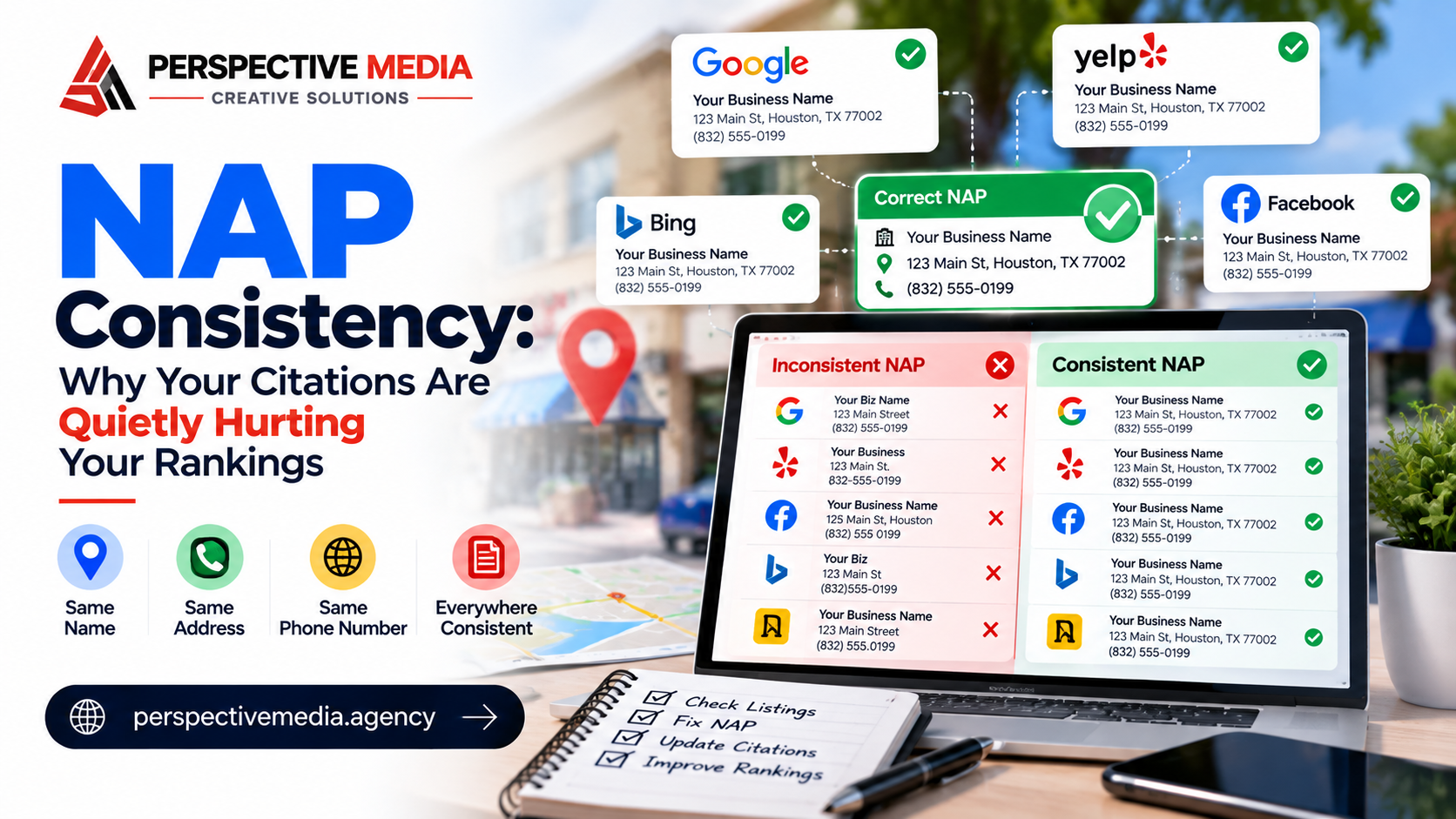
Your business name, address, and phone number appear on dozens of websites: Google, Apple Maps, Bing, Yelp, Facebook, industry directories, and data aggregators you’ve never heard of. When those listings disagree, Google loses confidence in your business details — and that shows up as lower map-pack visibility most businesses never trace back to the cause.
This is the problem of NAP consistency in local SEO: keeping your name, address, and phone number identical everywhere the internet lists your business. It sounds like admin work, but it’s one of the highest-leverage local ranking factors a small business can fix — almost everyone has drift, and the fix is systematic.
This guide explains what NAP drift looks like, how to audit it, and the exact order to fix your citations so the work moves rankings.
What NAP Consistency Means in Local SEO
NAP stands for Name, Address, Phone — the three facts that identify a local business across the web. NAP consistency means those three facts appear identically on your website, your Google Business Profile, and every citation (directory listing) that mentions your business.
Google uses citations to verify that your business is real and located where you claim. How Google ranks local results confirms that relevance, distance, and prominence decide local rankings — and consistent citations feed directly into prominence and trust. When ten sources agree on your details and three disagree, Google has to guess which version is right. Businesses that force Google to guess rank below businesses Google is sure about. Apple Maps, Bing, and voice assistants draw on the same citation ecosystem, so one cleanup improves visibility across all of them.
What NAP Drift Actually Looks Like
NAP drift is the slow accumulation of small inconsistencies. Few businesses create it deliberately; it builds up through moves, rebrands, staff changes, and automated data copying. Here is what it typically looks like in the wild:
The five most common drift sources
- Old addresses that never died. You moved premises in 2022, updated Google, and forgot the forty directories that still show the old street. Those listings don’t expire on their own.
- Suite and unit numbers. “Suite 4” on your website, “Ste. 4” on Yelp, no suite number at all on Facebook. Each variant is a slightly different address as far as matching algorithms go.
- Phone number formats and tracking numbers. Your site shows +44 20 7946 0018, a directory shows 02079460018, and your ads use a call-tracking number that leaked into three directories. Format differences are minor; genuinely different numbers are major.
- Name variations. “Perspective Plumbing Ltd” on the website, “Perspective Plumbing” on Google, “Perspective Plumbing & Heating” on Yell. Google’s business guidelines are strict about using your real-world name — and every variation dilutes the match.
- Aggregator copies. Data aggregators (Data Axle, Neustar Localeze, Foursquare) sell business data to hundreds of downstream directories. One wrong record at the aggregator level replicates itself across the ecosystem.
Why drift happens even when you never changed anything
Even a business that never moved accumulates drift. Aggregators refresh records from web crawls and user submissions — a customer “suggests an edit” with a wrong phone number, a scraper misreads your footer, and six months later fifteen sites carry the error. NAP consistency is maintenance, not a one-time setup.
How to Audit Your NAP Consistency
An audit has five steps and takes an afternoon for a single-location business. Do it once properly, and the maintenance version takes twenty minutes a quarter.
Step 1: Define your canonical NAP
Write down the single correct version of your name, address, and phone number — exactly as it should appear everywhere. Match it to your real-world signage and legal documents. This canonical NAP is the reference every listing gets corrected to. No step 2 works without step 1: you can’t spot “wrong” until you’ve defined “right.”
Step 2: Check the big aggregators first
The data aggregators feed everyone downstream, so errors here have the widest blast radius. Check your listing on the major aggregators (Data Axle, Neustar Localeze, Foursquare) and submit corrections where the record is wrong. A single corrected aggregator record can fix dozens of downstream listings over the following weeks as they re-sync.
Step 3: Check the directories that actually rank
Search your business name plus your city and open the first two pages of results. For most businesses the list that matters is short: Google Business Profile, Apple Maps, Bing Places, Facebook, Yelp, and two or three industry directories (Checkatrade, TrustATrader, or your trade’s equivalent). Record what each one shows for name, address, and phone against your canonical NAP.
Step 4: Scan the long tail
Beyond the directories that rank for your name, dozens of smaller sites may carry your listing. Citation tools (BrightLocal, Whitespark, and similar) scan hundreds of sources at once and flag mismatches. The Moz local search ranking factors survey consistently shows citation signals among the factors practitioners watch — a scan gives you the full inventory in one pass.
Step 5: Score and prioritize
Not every mismatch matters equally. Score each by visibility (does the site rank or get traffic?) and severity (a wrong phone number beats a missing suite number). This scored list becomes your fix queue.
The Fix Order That Actually Matters
Fixing citations in the wrong order wastes weeks. This is the sequence that moves rankings fastest:
- Your website first. Your site is the canonical source Google trusts most. Make sure the NAP in your footer, contact page, and schema markup matches your canonical NAP exactly — down to the suite abbreviation.
- Google Business Profile second. Name, address, and phone must match the website character for character. If you’re a service-area business, the address stays hidden but the underlying record still needs to be right — our service-area business setup guide covers that configuration.
- Data aggregators third. Correct the upstream sources so the fixes propagate instead of fighting you.
- High-visibility directories fourth. Apple, Bing, Facebook, Yelp, and your top industry directories.
- The long tail last. Work through the scan results in priority order. Duplicates get merged or removed, not just edited.
- Monitor quarterly. Re-run the scan every three months and fix new drift early.
One caution: never pay a service to “suppress” listings you could correct for free. Suppression hides a listing; correction fixes it — and a suppressed wrong listing can resurface when the aggregator re-syncs.
NAP Consistency Mistakes That Keep Hurting Rankings
Even businesses that do citation work often undermine it with these errors:
Fixing directories before fixing the website
Your website is the reference. If the footer still shows the old phone number while you correct fifty directories, you’ve just created fifty new mismatches against the source Google trusts most. Website first, always.
Letting tracking numbers leak into citations
Call-tracking numbers belong in ads, not in directory listings. Every directory that carries a tracking number instead of your real number is a NAP mismatch — and it also breaks the click-to-call experience for customers who find you organically. Keep one consistent public number everywhere; track calls at the source level instead.
Keyword-stuffing the business name across directories
“Best Emergency Plumber London 24/7” is not your business name. Adding keywords to directory listings while your GBP shows the real name creates the very mismatch you’re trying to eliminate. Use the same real name everywhere.
Ignoring duplicates instead of merging them
Two listings for the same business on one platform split your reviews and confuse matching. Claiming and merging duplicates is part of every cleanup — our GBP optimization checklist walks through profile hygiene that pairs with this work.
FAQs About NAP Consistency
Does NAP consistency still matter in 2026?
Yes. Citations remain a core trust signal — especially for competitive trades where review profiles look similar. When reviews and proximity are close, citation consistency is often the tiebreaker.
Should my phone number be identical everywhere?
The number itself must be identical; formatting differences (spaces, country codes) are tolerated but not ideal. Pick one format in your canonical NAP and use it everywhere, including in your website’s schema markup.
How long does a citation cleanup take to affect rankings?
Aggregator corrections typically propagate in 4–8 weeks; direct directory edits can reflect in days. Expect the full ranking effect within one to two quarters — foundation work, not a quick win, but work your competitors are probably skipping.
Stop Losing Rankings to Bad Data
NAP consistency won’t make headlines, but it’s the kind of unglamorous work that separates businesses Google trusts from businesses Google hedges on. Define your canonical NAP, audit the ecosystem, fix in the right order, and maintain it quarterly. The rankings you recover were yours all along — they were just buried under bad data.
If you’d rather have the audit and cleanup handled for you, our local SEO service covers citation audits, aggregator corrections, and ongoing NAP monitoring.