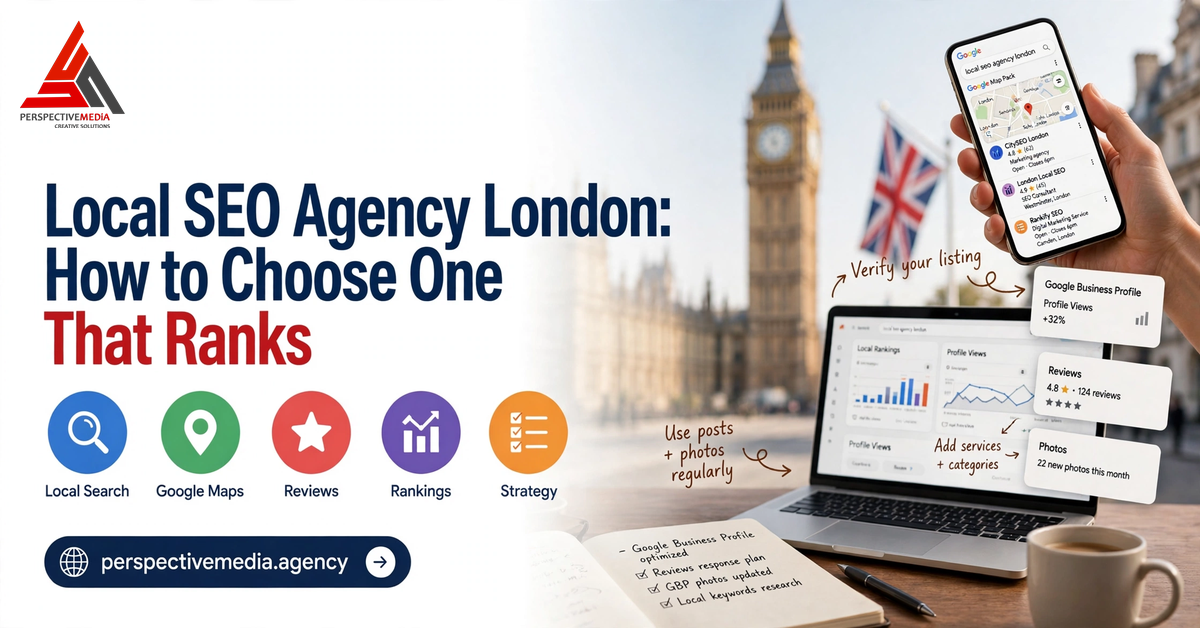
Choosing a local SEO agency in London is harder than it should be. Every agency on the first page of “local SEO agency London” claims to rank businesses — but a florist in Crouch End, a solicitor in Holborn and a plumber in Lewisham face completely different competitive landscapes, different map-pack dynamics, and different buyers. This guide gives you the diagnostic questions to ask on the first call, the proof points worth demanding, and the red flags that should send you walking.
What a Local SEO Agency in London Should Actually Do
Forget the deliverable list for a moment and think in outcomes. A serious agency wins you visibility where Londoners actually convert: the Google map pack, the organic results beneath it, and increasingly, AI Overviews that summarise local options. The work behind that breaks into five tracks:
- Google Business Profile optimisation. Categories, services, attributes, photos, posts, Q&A — the highest-leverage asset for most local businesses. Start with our Google Business Profile optimisation checklist to see what the full pass looks like.
- Local keyword and intent mapping. “Emergency plumber Ealing” and “plumber London” are different campaigns. Map which queries you can win now, matched to real service areas — borough by borough.
- On-page and local content. Location and service pages that read like they were written by someone who’s been to the area — not “plumber + {borough}” template spam. Built on the foundations of our local SEO services.
- Reviews and reputation velocity. A system for generating reviews ethically at scale — never buying them. Google’s own reviews policy is strict on fake engagement, and the right agency knows the line cold.
- Citations and local links. NAP consistency across directories, plus links from genuinely local sources: borough business groups, local press, community organisations. A link from the Southwark Chamber beats ten directory submissions.
Diagnostic Questions for the First Call
The first call is where you filter:
“Walk me through your first 30 days on my account”
You’re listening for specificity: GBP audit and category correction, citation audit, current rankings by borough, a technical crawl, a keyword map, a reporting dashboard you can check yourself. Vague answers — “we optimise your site and build links” — mean there is no playbook.
“Show me how you’d beat my specific competitors”
Ask them to pull up the map pack for your money keyword, live, and talk through who’s winning and why. If they can’t read a local SERP on the spot — the winner’s categories, review velocity, citation gaps — they can’t beat it later.
“What does your Google Business Profile process look like?”
The GBP is where the money is for most London local businesses. Demand detail: categories, service definitions, photo cadence, posting schedule, review-response protocol. Anyone who treats the profile as “set and forget” is leaving the map pack on the table.
“How do you handle reviews?”
Listen for a system: post-service review requests, review monitoring, professional responses to negative reviews. Anything involving buying reviews or review-gating is disqualifying — Google prohibits both the incentives and the deception.
“What’s your view on AI search and local?”
AI Overviews now answer a growing share of “near me” queries without a click. Your agency needs a point of view: structured data, FAQ-style content that gets cited, and entity completeness so AI systems describe your business accurately.
Proof Points Worth Demanding
Claims are cheap; evidence is the currency. Before you sign, ask for three things:
1. Live rankings for businesses like yours. Not screenshots — a live screen-share of Google searching their clients’ money keywords incognito. Weight the evidence by difficulty: map-pack presence for trades in competitive boroughs (Camden, Islington, Hackney) is harder than for niche B2B.
2. Before-and-after GBP metrics. Calls, direction requests and website clicks from the Business Profile, three months before versus six months after. The BrightLocal local search industry survey consistently shows the profile driving a huge share of local conversions — your agency should be able to show the same lift for its own clients.
3. A real local strategy document. Ask for an anonymised sample: the keyword map, the competitor gap analysis, the review generation plan. You’ll know a real one when you see it — it’s boring, specific, and full of numbers. A London agency that can’t explain why local differs from national SEO — map-pack eligibility, service-area targeting, citation ecosystems — is a generalist wearing a local costume; see what a genuine UK local SEO specialism covers.
Red Flags: When to Walk Away
Some signals are disqualifying, not debatable:
- Guaranteed rankings. Nobody controls Google. Agencies that guarantee positions are either lying or planning to rank you for keywords nobody searches. Visibility is earned, not purchased — and Google’s own guidance frames it exactly that way.
- “Secret sauce” or proprietary methods. Local SEO is public knowledge executed well. Mystery is a smokescreen for nothing-to-show.
- No questions about your business. A serious agency asks about your margins, your best postcodes, your close rate. If they quote before understanding what makes you profitable, they’re selling a package, not a partnership.
- One-size pricing with no audit. Fixed packages priced before a single audit are designed for the agency’s efficiency, not your results.
- Links from their “private network.” The modern euphemism for a link scheme — exactly what gets businesses penalised. Local links should come from local relationships.
- They treat reviews as your job. Reviews are a ranking factor, a conversion factor and a trust factor. Any agency that treats them as somebody else’s problem doesn’t understand local.
What Good Looks Like in the First 90 Days
So you’ve asked the questions, checked the proof, and signed with the right partner. Here’s a realistic picture of the first quarter — use it as your yardstick:
Days 1–30: foundations. Full GBP rebuild, citation audit and NAP cleanup, technical crawl and quick wins, keyword map by service area, competitor gap analysis. You should receive the strategy document this month — not in month three.
Days 31–60: content and citations. Location and service pages published, citation building in motion, review generation system live, first GBP posts cadence running. Expect first movement in less competitive terms and a measurable uptick in profile actions.
Days 61–90: momentum. Rankings trending for mid-difficulty terms, review velocity climbing, a reporting dashboard you actually look at. Nobody should promise page one in 90 days for “solicitor London” — but a competent agency shows trajectory, not excuses.
If month two arrives with no strategy document, no review system and no visible GBP activity, you hired the wrong agency. Say so early; the sunk cost only grows.
Local SEO Agency London: FAQs
How much should a local SEO agency in London cost?
London pricing: meaningful campaigns start in the low four figures per month for competitive trades and B2B, lighter for niche businesses in quiet boroughs. Avoid anything under a few hundred pounds a month and retainers that never change with your competitive set. Price should follow the audit, not precede it.
How long does local SEO take to work in London?
Expect 3–6 months for meaningful movement in competitive London boroughs, with the map pack often responding faster than organic — GBP improvements can shift visibility in weeks. Anyone promising the map pack in 30 days for a competitive keyword is selling fiction.
Should I hire a London-specific agency or any UK agency?
Local knowledge is a genuine edge: an agency that knows the boroughs, service-area dynamics and local directories builds better location content and earns better local links. That said, a non-London agency with deep local SEO expertise and London case studies can outperform a weak local one. Judge the proof, not the postcode — but all else equal, London experience wins.
Do I need local SEO if I already run Google Ads?
Yes — they compound. Ads buy the top slot; local SEO owns the map pack and organic beneath it, and a strong organic presence lowers paid costs over time through better Quality Scores and brand familiarity. Most London businesses should run both, then lean on organic as it matures.
Can a local SEO agency help a service-area business with no shopfront?
Absolutely — and it’s a specialism worth asking about directly. Service-area businesses (plumbers, electricians, mobile services) hide their address and define service areas in the Business Profile instead. The tactics differ: stronger emphasis on service-area pages, review velocity and local links over foot-traffic signals. Make sure your agency has done it before.
If you’re weighing up a partner right now, start with the call, not the proposal. The questions above take twenty minutes, and the difference between a confident, specific answer and a vague one is the difference between an agency that ranks and an agency that invoices. The right local SEO agency in London will show you the map before asking for the commitment.