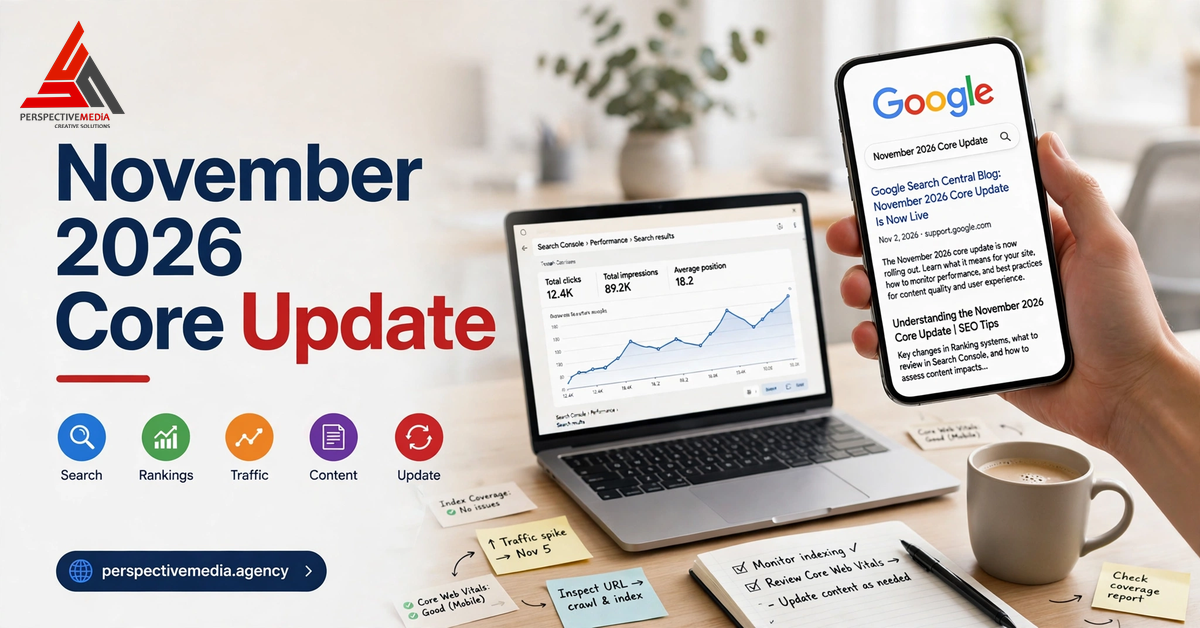
Google released the November 2026 core update on November 10, and it is rolling out now. It is the third core update of 2026, it applies globally and in every language, and Google says the rollout may take up to two weeks to complete. Rankings will keep shifting until around November 24. This post explains what happened, what a core update actually does, how to check whether your site is affected, and what to do while it rolls out.
What Happened on November 10
Google posted the November 2026 core update on its Search Status Dashboard on November 10, 2026, at 18:06 UTC. The dashboard entry reads: “Released the November 2026 core update, which applies globally and to all languages. The rollout may take up to 2 weeks to complete.” That is the whole announcement. Google has said nothing about what specifically changed, and that is normal for a core update.
This is the third broad core update of 2026, after the March and May updates, and the first confirmed ranking update since the September 2026 spam update, which ran from September 24 to October 8. SEO trackers had reported unusual volatility in late October, but Google had confirmed nothing until now.
The timing matters. A two week rollout means rankings can move on day one, settle, then move again as the rollout reaches different systems. A drop on November 13 may reverse by November 20, so judging a core update before it finishes is like judging a match at half time.
What a Core Update Actually Does
A core update is a significant, broad change to how Google ranks pages. Google is explicit that these updates do not target specific sites or individual pages. No single ranking factor gets switched on or off. Instead, Google reassesses how its systems judge content quality across the whole web, and pages move up or down based on how they compare afterwards.
That distinction changes how you should respond. A spam update punishes specific tactics. A core update rewards or demotes content based on overall quality. If your rankings fall, Google is not saying your site did something wrong. It is saying that, after the reassessment, other pages now look more helpful, reliable, and people first for those queries. Google has folded its old helpful content system into the core ranking systems, so that judgement now covers original reporting and genuine expertise too.
Google also makes smaller core updates all the time without announcing them. Rankings reflect an ongoing judgement of content quality, not a fixed score your pages earned once and keep forever.
How to Check Whether the November 2026 Core Update Affected You
Start by doing nothing for a few days. The most common mistake during a rollout is reacting to daily noise. Wait until it completes, around November 24, then follow this sequence.
Confirm the rollout has finished. Check the Search Status Dashboard entry. Google marks it complete when the rollout ends. Do not start your analysis before that date.
Compare like with like in Search Console. Open the Performance report and compare the week after the update completes with the week before it started. Google’s core updates documentation recommends waiting at least a full week after completion before analysing. A one day comparison proves nothing. A week over week comparison tells you what actually moved.
Segment before you panic. A sitewide drop and a drop on five pages are different problems. Break the data down by page type, topic, and query. If service pages held steady and blog posts fell, that points at content quality. If everything fell a little, that is usually a broad reassessment, and the fix is broad too. Our November 9 analysis of AI Overviews traffic loss explains how to separate a ranking drop from clicks lost to AI Overviews.
Ignore small movements. A page that slips from position 6 to 8 has not been punished. Core updates shuffle the middle of page one constantly. Google’s guidance is clear: small drops are not a reason to act. Only a large, sustained drop across your site as a whole warrants a full review.
What to Do While the Rollout Runs
There is no fix for a core update, because there is nothing specific to fix. But there are useful things to do while you wait.
Do not rewrite pages mid-rollout. Editing a page on November 12 because it dropped on November 11 is guesswork. You cannot tell whether the drop is the update, a temporary fluctuation, or a page already sliding. Wait for the rollout to finish, then decide.
Check the technical basics. A core update is a bad time to discover crawl errors, a stale sitemap, or a site that slowed down after a plugin update. Check Search Console coverage, Core Web Vitals, and a crawl of your key pages. These remove noise from your analysis.
Read your own content like a customer. Pick your ten most important pages and read them as if you had just searched for the topic. Does the page answer the question quickly? Does it show real experience? Would you trust this business based on this page alone?
Review your robots.txt and AI training settings. The update landed a week after the new shared AI training opt-out token made headlines. Our guide to the AI training opt-out robots.txt token explains the one line that covers Google, Microsoft, OpenAI, and Anthropic.
Keep publishing. A core update rewards sites that consistently produce helpful content. Pausing your content plan for two weeks while you watch rankings is the worst response. Keep your normal rhythm.
If Your Traffic Drops, Here Is the Recovery Playbook
If, after the rollout completes and a full week has passed, you have a large, sustained drop, work through this in order.
First, run Google’s self-assessment honestly. It covers content quality, expertise, presentation, and comparison with competitors. Most sites that lose traffic in a core update can find the reason there. Thin pages, content written to rank rather than to help, and pages that repeat what ten competitors already say better are the usual causes.
Second, improve the pages that matter most: the ones that lost the most clicks and the ones that earn you money. Rewrite them to be genuinely more useful, with specifics only you know, answers to the follow-up questions searchers ask, and no filler. One deeply improved page beats ten lightly tweaked ones.
Third, accept the timeline. Improvements can take effect in days, but it can also take months for Google’s systems to confirm that a site is now consistently producing helpful, people first content. There is no resubmission button. You improve, you wait, and recovery shows at the next reassessment.
Fourth, do not chase tactics. No plugin, schema trick, or internal linking pattern reverses a core update drop on its own. If someone sells you a recovery package with a guaranteed timeline, they are selling confidence, not a service.
What the November 2026 Core Update Means for UK, UAE, Saudi and South African Sites
Because this update applies globally and to all languages, it affects every market we serve. English language content in the UK, UAE, Saudi Arabia, and South Africa is judged by the same systems. That is good news for businesses in our markets, because competition for commercial keywords in the UAE, Saudi Arabia, and South Africa is thinner than in the UK or US, so a site that genuinely answers its customers’ questions stands out faster.
Local search deserves a note. Core updates affect organic rankings, and the map pack runs on a partly separate system, but the two are connected. A business whose website shows real expertise and local relevance tends to do better in both. If you operate in Dubai, Riyadh, London, or Johannesburg, the update does not change your local SEO fundamentals. It raises the value of doing them well. Our guide to how to get cited in AI Overviews covers the same quality principles from the AI search angle.
Frequently Asked Questions
How long will the November 2026 core update take to roll out?
Google says the rollout may take up to two weeks from November 10, so it should complete around November 24, 2026.
Should I change my website during a core update?
No, not based on daily movements. Wait until the rollout completes, then wait at least another full week before analysing Search Console data. Only a large, sustained drop warrants changes, and those should be content improvements, not quick fixes.
Does the November 2026 core update target AI content?
Google has not said that. Core updates are broad reassessments of content quality, not penalties aimed at a specific type of content. Pages are judged on whether they are helpful, reliable, and people first.
If you want a second opinion on how the November 2026 core update affected your site, our services page explains how we work, and you can talk to us about an audit of your current position once the rollout completes.