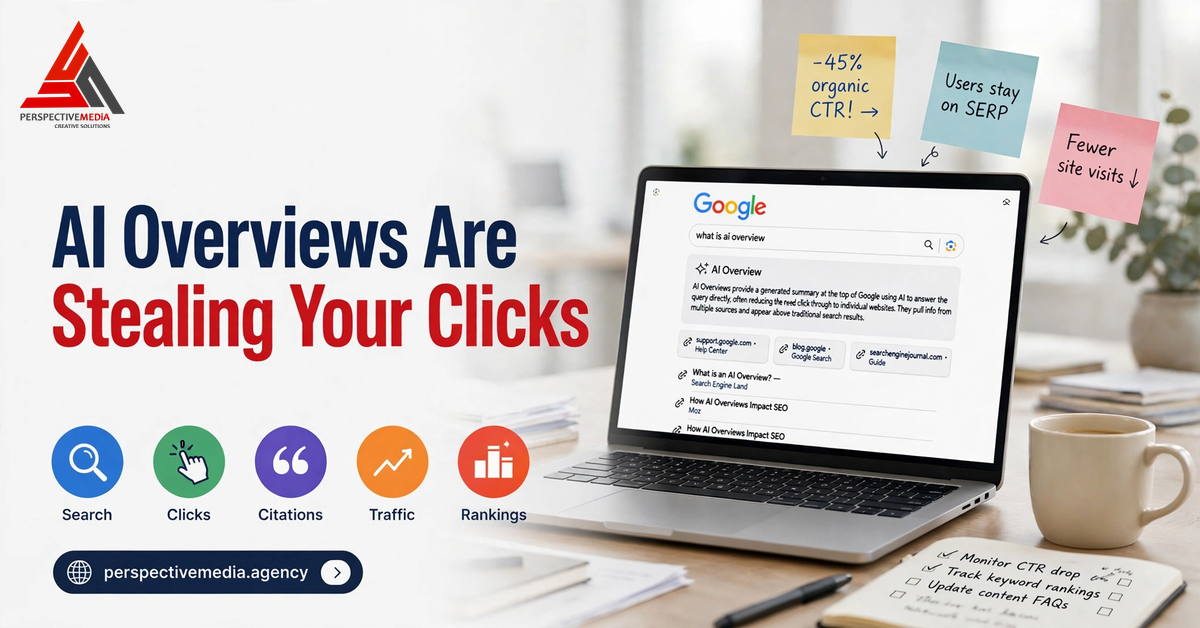
If your rankings look steady but your traffic keeps sliding, you are probably dealing with AI overviews traffic loss. Your pages still rank and your impressions may even be growing, but fewer people click through, because Google answers the question right there on the results page. It is a structural change in how search works, and it needs a different response than the usual SEO fixes.
What AI Overviews Traffic Loss Looks Like in the Data
The scale of the shift is now measurable. Pew Research Center analysed the browsing behaviour of 900 US adults in March 2025 and found that people who saw an AI summary clicked a traditional search result in only 8% of visits, compared with 15% when no summary appeared. Only 1% of users clicked a link inside the summary itself. And 26% ended their browsing session entirely after a page with an AI summary, against 16% on pages without one.
Those numbers explain what many site owners feel but cannot prove. The click did not move to a competitor. It disappeared. Around one in five searches in the study produced an AI summary, and question searches triggered one 60% of the time.
That pattern should change how you read your own analytics. A page can hold position one, gain impressions, and still lose half its clicks. If you only watch rankings, you will miss the story entirely. The traffic loss is concentrated on informational queries, the how-to and what-is searches that used to be the backbone of blog traffic. Transactional and local searches are affected less, because people still need to visit a website to buy, book, or call. You can read the full findings in the Pew Research Center study.
How to Measure AI Overviews Traffic Loss on Your Site
Before you change anything, measure the damage properly. Google Search Console does not flag AI Overview impressions separately, so you have to triangulate. Start with the queries that matter most to your business and look at three things for each one.
First, compare clicks and impressions over the last three months. A query where impressions are flat or rising while clicks fall is the classic signature. Second, look at click-through rate by query, not by page, because only the informational ones will show the drop. Third, split branded and non-branded traffic. Branded searches still convert to clicks. Non-branded informational queries are where the loss concentrates.
Check the same queries manually in Google, signed out, once a week. Note which ones trigger an AI Overview and whether your site is cited in it. Search Console will not tell you, so keep a simple log of query, overview, citation, position, and CTR. After a month you will see exactly which pages are losing clicks to summaries and which ones are holding up. Our AI Overviews update guide covers the monitoring routine in more detail, and the SparkToro zero-click research explains why so many searches now end without a click at all.
Why Some Pages Lose Clicks and Others Win Citations
Not every page loses equally. Some pages keep their clicks. Others lose clicks but gain something else: citations inside the AI Overview. Understanding the difference is the whole game.
Pages that lose the most share three traits. They answer a simple factual question in the first paragraph. They say nothing a competitor could not say. And they offer no reason to visit beyond the answer itself. If the answer fits in a 67-word summary, and the median AI summary is about that length, Google has no reason to send the user anywhere.
Pages that get cited look different. They give a direct answer, then add something the summary cannot reproduce: original data, a worked example, a comparison, or a point of view. They use clear headings, short paragraphs, and lists, so an AI system can lift a clean passage. They name the entities that matter, the products, the places, the standards, so the system can connect the page to the topic. And they stay current, because an overview that cites a stale page is a bad answer.
The citation is not a consolation prize. It is the new front door. Users who do click from an overview tend to be further along in their decision, and they arrive with more trust, because Google just told them your page is a good source. Losing the casual click and winning the cited click is a trade worth making.
The Playbook: Six Moves That Bring Clicks Back
Here is the practical response, in order of impact.
1. Win the citation. Rewrite your most important informational pages so the answer is unmissable. Put a direct, plain-language answer in the first 100 words, then support it with detail. Use headings that match the question people actually ask. Add a short FAQ section to the pages that matter. Our guide on how to get cited in AI Overviews walks through the content patterns that earn citations.
2. Build branded demand. The clicks AI cannot take are the ones aimed at you by name. Every piece of content should give people a reason to remember your business and search for it directly. That means original research, useful tools, clear opinions, and content worth returning to. Branded searches still click through at normal rates, and they convert far better than generic traffic.
3. Target the queries AI answers badly. AI Overviews are strong on facts and weak on judgement. They struggle with comparisons that depend on real experience, with local detail, with pricing trade-offs, and with anything that needs a current, hands-on answer. Shift some of your content toward those queries. A comparison based on work you have actually done will outperform a generic explainer every time.
4. Make the page worth the click. If the only value on the page is the answer, the summary replaces it. Add what a summary cannot carry: a downloadable checklist, a calculator, a video walkthrough, screenshots from real work, or data from your own clients.
5. Write titles and descriptions that earn the click. When a user sees both a summary and your result, the title and description decide whether they bother. Be specific. Promise the detail, the number, or the comparison that the summary does not have.
6. Strengthen your entity signals. AI systems cite sources they can identify with confidence. Make sure your site clearly states who you are, what you do, where you work, and what you have done. Consistent business details, a complete author bio, and clear internal links between related pages all help. Our guide to entity SEO explains how Google builds that understanding, and generative engine optimisation covers the wider shift toward AI-mediated search.
What Not to Do
Three common reactions make things worse. First, do not block AI crawlers and expect traffic to return. Blocking Google-Extended keeps your content out of AI training data, but it does not remove AI Overviews or restore clicks, and it can cost you the citations you do have. Second, do not stuff your pages with keywords in the hope of forcing a ranking gain. The problem is not your ranking. It is the interface. Third, do not chase every query you lost. Some informational traffic was never going to convert. Spend your effort on the pages that support real business goals, and let the trivia go.
Google’s own AI Overviews documentation is the best place to check how the feature works and what site owners can control. Read it before you act on any advice, including ours.
Frequently Asked Questions
How much traffic can AI Overviews take from a site?
It varies by query type. Informational content can lose a large share of clicks, with Pew finding click rates roughly halved when a summary appears. Transactional and local pages lose far less, because users still need to visit a site to buy or book.
Can I stop my content appearing in AI Overviews?
No reliable switch exists. You can control some AI features through Search Console settings and robots rules, but these do not remove AI Overviews. The practical approach is to win citations and shift toward content that earns the click.
Does being cited in an AI Overview bring traffic?
Sometimes, but less than a top ranking used to. Only about 1% of users in the Pew study clicked a link inside a summary. The value is visibility, trust, and the higher-intent clicks that do come through.
Should small businesses still invest in blog content?
Yes, but invest differently. Generic explainers are the most exposed to summary replacement. Content built on your own experience, data, and local knowledge is far harder to replace, and it is the content that earns citations and branded searches.
If you want help measuring the impact on your own site and rebuilding the pages that matter most, talk to us and we will start with the queries already costing you traffic.